
ATLANTA, Georgia, May 8, 2026 -- Descartes Systems Group, the global leader in uniting logistics-intensive businesses in commerce, released its May Global Shipping Report for logistics and supply chain professionals. In April 2026, U.S. container import volumes decreased by 3.2% over March to 2,277,965 twenty-foot equivalent units (TEUs). China-origin imports decreased 4.3% month-over-month and 15.3% year-over-year. West Coast ports reclaimed market share lead over East and Gulf Coast ports and port transit delays improved broadly over March. Ongoing tensions in the Middle East continue to disrupt key maritime corridors and U.S. trade policy remains in flux, with Section 122 tariffs in place, tariff refunds targeted to begin on May 12, uncertainty surrounding future policy extensions, and unresolved trade relations with the EU, India and China. The April update of the logistics metrics monitored by Descartes reinforces a global shipping environment defined by volatility, shifting sourcing strategies and heightened costs.
U.S. container imports ease slightly in April following March rebound.
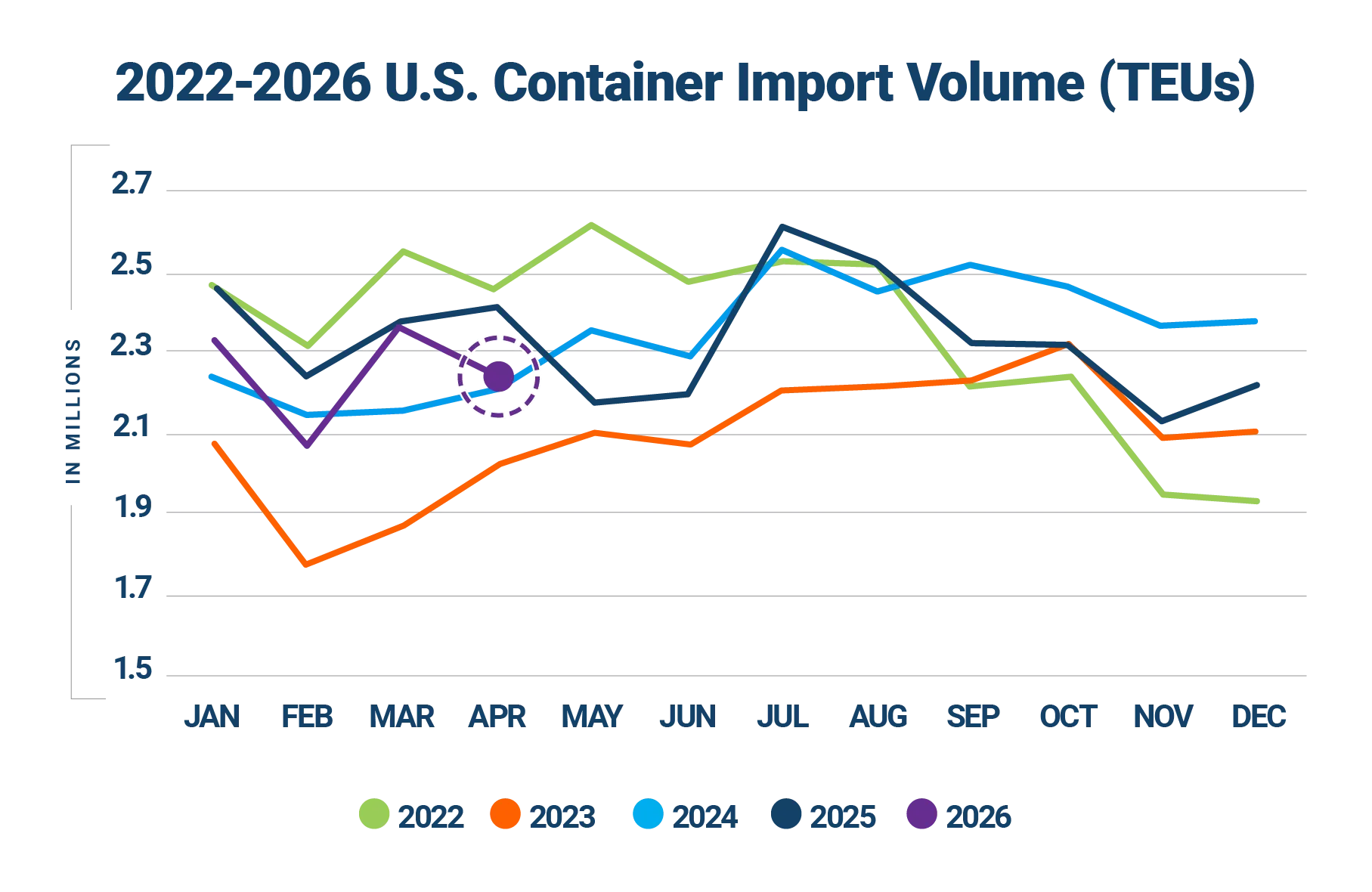
April imports were down 3.2% over March and 5.5% compared to April 2025 (see Figure 1). The moderate pullback after the month-over-month rebound in March suggests volumes continue to reflect underlying demand despite ongoing policy uncertainty. Imports remained elevated relative to pre-pandemic levels, standing 18.7% above April 2019. Year-to-date, imports are trailing 2025 levels by 5.0%.
Figure 1. U.S. Container Import Volume Year-over-Year Comparison
Source: Descartes Datamyne™
Imports from top countries of origin (CoO) declined in April, with mixed performance across key markets.
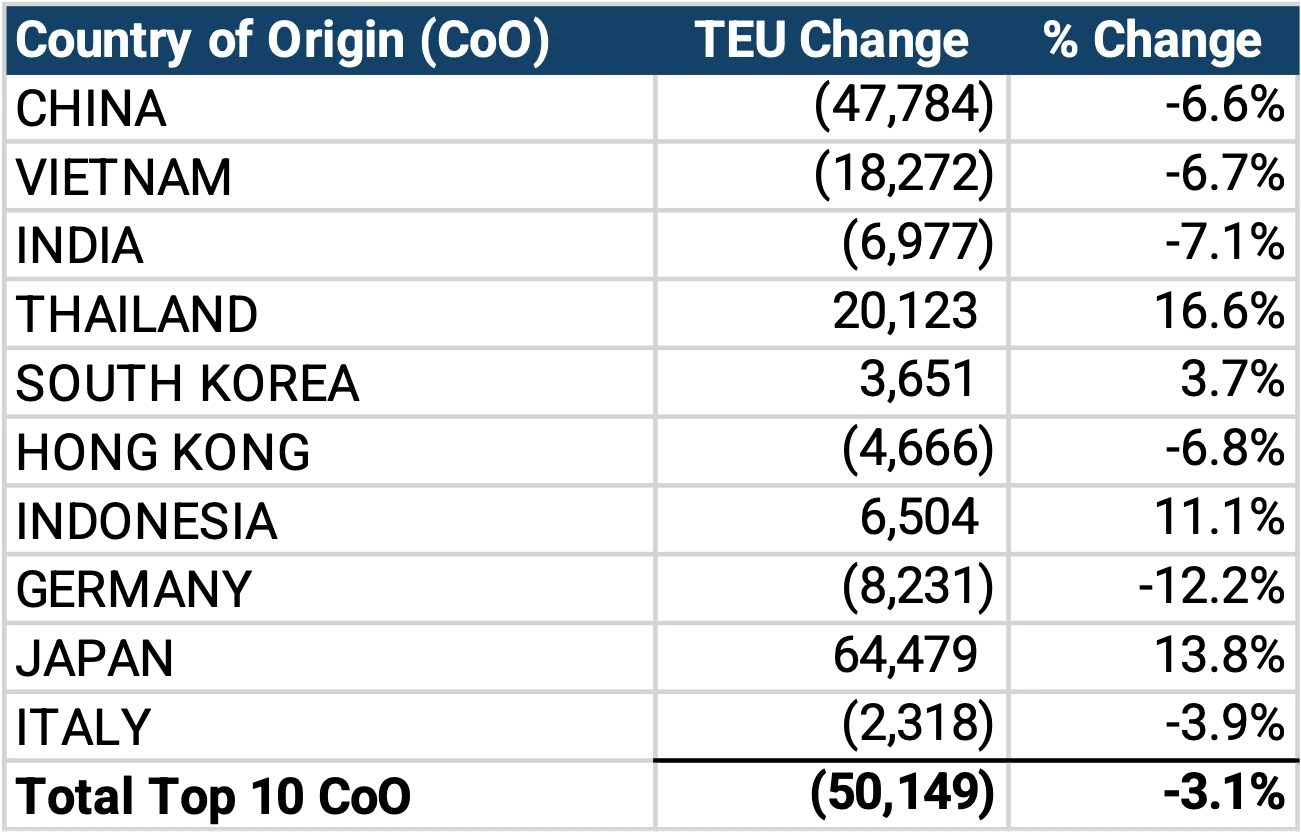
April U.S. containerized imports from the top 10 CoO decreased 3.1% (50,149 TEUs) month-over-month (see Figure 2). Performance was mixed, with gains concentrated in Japan (64,479 TEUs), followed by Thailand (20,123 TEUs), Indonesia (6,504 TEUs) and South Korea (3,651 TEUs). Declines were more widespread, as China posted the largest drop (47,784 TEUs) followed by Vietnam (18,272 TEUs), India (6,977 TEUs), Germany (8,231 TEUs), Hong Kong (4,666 TEUs) and Italy (2,318 TEUs). Overall, April results reflect a broad-based pullback in import volumes across key sourcing markets, with gains in select countries unable to offset declines led by China and other major exporters.
Figure 2. March 2026 to April 2026 Comparison of U.S. Import Volumes from Top 10 Countries of Origin
Source: Descartes Datamyne™
“So far in 2026, U.S. maritime import volumes have remained relatively resilient despite ongoing trade uncertainty and heightened geopolitical volatility,” said Jackson Wood, Director of Industry Strategy at Descartes. “With geopolitical disruption, tariff uncertainty and shifting trade dynamics continuing to pressure global supply chains, greater emphasis on flexibility, cost control and more diversified sourcing strategies are key focus areas for U.S. importers.”
Descartes began its global shipping analysis in August 2021. To read past monthly reports, learn more about the key economic and logistics factors driving global shipping, and review strategies to help address challenges in the near-, short-, and long-term, visit Descartes’ Global Shipping Resource Center.
About Descartes
Descartes powers more responsive, efficient, secure and sustainable international and domestic supply chains by uniting logistics-intensive businesses on its Global Logistics Network (GLN). Shippers, carriers, and logistics service providers connect and collaborate on the GLN leveraging technology, data and AI to manage last mile deliveries, domestic and international shipments, transportation rating and payment, global trade research, customs compliance and a variety of regulatory processes. Learn more about Descartes (Nasdaq:DSGX) (TSX:DSG) at www.descartes.com and connect with us on LinkedIn and X.
Global Media Contact
Cara Strohack
Tel: 226-750-8050
cstrohack@descartes.com
Cautionary Statement Regarding Forward-Looking Statements
This release contains forward-looking information within the meaning of applicable securities laws (“forward-looking statements”) that relate to Descartes’ global trade intelligence solution offerings and potential benefits derived therefrom; and other matters. Such forward-looking statements involve known and unknown risks, uncertainties, assumptions and other factors that may cause the actual results, performance or achievements to differ materially from the anticipated results, performance or achievements or developments expressed or implied by such forward-looking statements. Such factors include, but are not limited to, the factors and assumptions discussed in the section entitled, “Certain Factors That May Affect Future Results” in documents filed with the Securities and Exchange Commission, the Ontario Securities Commission and other securities regulatory authorities across Canada including Descartes’ most recently filed annual and interim management’s discussion and analysis which are available under Descartes’ profile through the EDGAR website at http://www.sec.gov or through the SEDAR+ website at http://www.sedarplus.com/. If any such risks actually occur, they could, among other consequences, materially adversely affect our business, financial condition or results of operations. In that case, the trading price of our common shares could decline, perhaps materially. Readers are cautioned not to place undue reliance upon any such forward-looking statements, which speak only as of the date made. Forward-looking statements are provided for the purposes of providing information about management’s current expectations and plans relating to the future. Readers are cautioned that such information may not be appropriate for other purposes. We do not undertake or accept any obligation or undertaking to release publicly any updates or revisions to any forward-looking statements to reflect any change in our expectations or any change in events, conditions or circumstances on which any such statement is based, except as required by law.