
Organizations operating under the International Traffic in Arms Regulations (ITAR) face increasing pressure to maintain visibility and control over export licensing activities as global operations expand and scrutiny of controlled exports remains high. International supply chains, foreign subsidiaries, technical collaborations, and larger volumes of controlled transactions can generate a steady flow of ITAR license applications, agreement amendments, shipments, reporting obligations, and recordkeeping requirements.
As ITAR licensing activity grows, trade compliance teams must track what has been approved, how authorizations are being used, which agreements support specific transactions, what obligations remain outstanding, and when amendments or renewals may be required.
Managing that information through spreadsheets, email chains, and disconnected repositories becomes increasingly difficult. Many organizations therefore focus not only on obtaining authorizations but also on establishing repeatable processes for managing the full export authorization lifecycle.
This article examines ITAR license requirements, common authorization types, operational practices, and trade compliance software capabilities that can help organizations manage Department of State (DOS) licensing at scale.
Key Takeaways
- ITAR authorizations include export licenses, agreements, exemptions, and other approval mechanisms required for controlled exports, technical data transfers, and defense services.
- As ITAR licensing activity grows, managing authorizations often becomes more difficult with disconnected compliance processes.
- Technology can improve consistency and control across the ITAR license lifecycle, streamlining qualification, DECCS workflows, post-approval controls, and audit readiness.
- ITAR compliance software like Descartes OCR Global EASE™ help organizations centralize DDTC license management while supporting global operations and growth.
What Is an ITAR License?
An ITAR license is an authorization issued by the U.S. Department of State's Directorate of Defense Trade Controls (DDTC) for certain exports, temporary imports, and transfers of defense articles, technical data, and defense services regulated under the International Traffic in Arms Regulations.
Depending on the transaction, including physical exports, technical data transfers, defense services, and certain deemed export scenarios, an organization may require:
- A license authorizing a specific activity
- An agreement governing broader collaboration, technical assistance, or manufacturing activities
- Another type of authorization permitted under ITAR
The authorization required depends on factors such as the item involved, the destination, the parties involved, and the nature of the activity being conducted.
ITAR Licenses vs. Agreements
Licenses generally authorize specific transactions, while agreements are designed to govern broader ongoing relationships involving controlled technical data, defense services, or manufacturing activities. Organizations often manage both licenses and agreements simultaneously, making visibility across related authorizations an important part of ITAR compliance oversight.
Common Types of ITAR Licenses and Agreements
Understanding the primary ITAR licenses and agreements, as well as when license exemptions may apply, is an important first step toward ITAR compliance. Organizations must also understand how those authorizations are maintained over time. As programs evolve, approved authorizations may require updates through amendments or other regulatory mechanisms.
For example, a company may need to update a freight forwarder following a logistics provider change, revise licensing information after a corporate acquisition, or correct information submitted on the original authorization. In certain circumstances, these changes may be handled through an amendment rather than requiring an entirely new authorization.
DSP-5: Permanent Export License
A DSP-5 authorizes the permanent export of unclassified defense articles and related unclassified technical data regulated under ITAR. It is one of the most commonly used DDTC authorizations and frequently supports international defense sales, transfers of controlled technical information, and other permanent export activities.
DSP-6: Amendment Form to DSP-5 License
A DSP-6 is used to request an amendment to an existing DSP-5 license. DDTC may consider a DSP-6 for limited changes, including adding a U.S. consignor, correcting certain typographical errors, changing the U.S. source or manufacturer, or making changes resulting from a company relocation. A DSP-6 cannot be used to increase quantities, add new commodities, change the country of ultimate destination, change the end use or end user, extend the license duration, or make other substantive changes that require submission of a new ITAR license application.
DSP-73: Temporary Export License
A DSP-73 authorizes the temporary export of unclassified defense articles from the United States when the items will subsequently be returned. Organizations commonly use DSP-73s for activities such as product demonstrations, testing, evaluation, repair, exhibitions, and similar temporary transfers.
DSP-74: Amendment Form to DSP-73 License
A DSP-74 is used to request an amendment to a DSP-73 temporary export license. Like other DOS license amendments, it is intended for limited administrative changes permitted by DDTC regulations. Changes involving quantities, commodities, destinations, end users, end uses, or license duration generally require a new authorization rather than an amendment.
DSP-61: Temporary Import License
A DSP-61 license authorizes the temporary import of unclassified defense articles into the United States. Organizations may use DSP-61 licenses for activities such as testing, inspection, evaluation, repair, modification, or demonstration involving defense articles entering the U.S. temporarily before being returned or otherwise authorized for disposition.
DSP-62: Amendment Form to DSP-61 License
A DSP-62 is used to request an amendment to a DSP-61 temporary import license. It is intended for specific administrative changes authorized by DDTC. Material changes to the transaction generally require submission of a new authorization rather than an amendment.
DSP-85: Classified Export License
A DSP-85 authorizes the permanent export of classified defense articles and classified technical data. Because these transactions involve classified material, they are subject to additional security and handling requirements beyond those associated with unclassified exports.
Unlike the DSP-5, DSP-73, and DSP-61 authorization families, there is no separate paired amendment form associated with the DSP-85. Amendment requests relating to classified export authorizations are handled through DDTC processes applicable to classified licensing matters.
Technical Assistance Agreements
A Technical Assistance Agreement (TAA) authorizes the provision of defense services and the transfer of controlled technical data to foreign persons. TAAs are commonly used when organizations collaborate internationally on engineering, development, integration, testing, training, or other defense-related activities that involve controlled technical information.
Manufacturing License Agreements
A Manufacturing License Agreement (MLA) authorizes a foreign party to manufacture defense articles using approved U.S. technical data, defense services, or manufacturing know-how. MLAs are often used to support approved international manufacturing arrangements and production relationships involving ITAR-controlled items.
The ITAR License Lifecycle: How Authorizations Are Acquired and Managed
An ITAR authorization often represents the culmination of weeks or months of classification reviews, party screening, data collection, documentation gathering, and internal approvals. Once issued, compliance teams must continue managing amendments, evolving program requirements, authorization utilization, recordkeeping, reporting obligations, and renewals. Each stage of the lifecycle introduces its own operational challenges, many of which become more difficult as ITAR licensing activity grows.
Stage 1: Export License Request and Qualification
The ITAR licensing process often begins when a business unit identifies a planned export, import, technical data transfer, defense service, foreign-person engagement, or other activity that may require authorization.
One of the earliest challenges is ensuring compliance teams are aware of the transaction or activity before commitments are made, shipments are scheduled, or technical discussions are had. Information may originate from engineering, program management, contracts, human resources, procurement, or logistics teams, making early coordination essential.
Delays are frequently encountered when requests arrive with incomplete information regarding products, parties, destinations, technical data, or intended end uses.
Stage 2: ITAR Classification and License Determination
Before an application can be prepared, organizations must determine whether ITAR licensing requirements apply and identify the appropriate authorization mechanism. Accuracy in the export classification stage is critical because it influences licensing conditions, documentation, provisos, and downstream trade compliance obligations
1. Jurisdiction Determination
The first step is determining whether the item, technical data, or defense service falls under ITAR jurisdiction or another export control regime like the Export Administration Regulations (EAR).
Jurisdiction reviews can become particularly challenging when products contain both commercial and defense-related capabilities, involve emerging technologies, or have undergone multiple design iterations over time.
2. USML Classification
Organizations must determine the appropriate U.S. Munitions List (USML) category and subparagraph applicable to the item or activity. Maintaining consistent classifications across programs, business units, and acquired entities can become difficult without centralized records and governance processes.
3. Denied Party Screening
All relevant transaction parties should be screened against applicable government watchlists and eligibility requirements. A common pain point is reviewing, documenting, and incorporating screening outcomes into ITAR licensing and shipment-release decisions.
4. Destination and End-Use Review
Compliance teams must evaluate destination countries, end users, and intended end uses to identify potential restrictions, provisos, reporting obligations, or policy concerns. Gathering complete and accurate information for an end-use/end-user statement requires coordination among internal and external stakeholders.
Stage 3: ITAR License Application Preparation and Submission
Once ITAR licensing requirements have been identified, organizations must assemble the information required to prepare and submit an application through DECCS. Before applying for a license, manufacturers and exporters must maintain an active DDTC registration. It is important to distinguish registration from an ITAR license application or export authorization, as being registered on DDTC alone does not permit exports.
This stage often involves collecting:
- applicant, consignee, and end-user information
- product, technical data, and USML classification details
- supporting documentation and contractual records
- end-use information
- purchase orders and letters of explanation
- agreement and authorization records
Data collection across multiple business functions and systems can be one of the most time-consuming stages of the licensing lifecycle. While these challenges have existed for years, recent DDTC modernization initiatives and ongoing DECCS enhancements have increased the emphasis on complete, structured, and consistent application data. Compliance teams often spend significant time coordinating stakeholders, managing application reviews, obtaining Empowered Official approvals, maintaining version control, and validating supporting documentation before submission.
Stage 4: DDTC Review and Authorization Approval
Following submission in DECCS, applications enter DDTC review and adjudication processes. During this stage, compliance teams are responsible for monitoring application status, responding to agency inquiries, and coordinating follow-up requests across internal stakeholders.
Requests for Information (RFIs) typically require additional technical, commercial, or end-use details from multiple teams. Organizations may also need to address Returned Without Action (RWA) determinations that require corrections and resubmission, or denials that can affect program schedules and customer commitments.
Another challenge is maintaining ITAR licensing records after submission. While DECCS serves as the submission system, separate processes and repositories to retain data and documentation for related to the DDTC license application.
Stage 5: ITAR License Usage and Quantity Management
ITAR compliance requires tracking how licenses and agreements are utilized, monitoring approved quantities and values, and ensuring activities remain within the scope of the authorization.
Managing Provisos and Approval Conditions
ITAR authorizations can contain provisos or other approval conditions that may restrict how an authorization can be used, impose reporting obligations, require notifications, or establish specific compliance requirements. Organizations commonly struggle with operationalizing how approved conditions are communicated, understood, applied, and documented across engineering, program management, logistics, and compliance functions.
Incrementation and Decrementation
Many ITAR authorizations involve approved quantitative or monetary limitations. To prevent compliance violations, quantity and value utilization, license balances, and activities conducted under agreements need to be monitored. Tracking decrementation manually can become increasingly difficult as shipment volumes increase, multiple business units consume authorizations, or freight forwarders play a role in export execution.
Stage 6: ITAR Authorization Amendments
Unlike the initial application process, amendments are often triggered by changes that occur in the middle of ongoing export activities. Evaluating how those changes affect approved authorizations, related agreements, and ongoing operations can introduce additional coordination challenges. Preserving a clear audit trail between the original authorization and subsequent modifications, while ensuring teams are working from the most current approved version, becomes increasingly important.
Stage 7: ITAR License Renewals and Authorization Retirement
ITAR licenses and agreements eventually expire, are superseded, or are otherwise retired from active use. Missed renewal deadlines can disrupt business operations, while retaining outdated records can create confusion regarding current authorization status.
Stage 8: Audit, Recordkeeping, and Reporting
Throughout the authorization lifecycle, organizations must maintain sufficient records to support compliance obligations, internal reviews, and regulatory audits. This can include:
- License applications
- Amendments
- Agreements
- Provisos
- Technical data records
- Shipment history
- Utilization records
- Correspondence
- Supporting documentation
As authorization volumes grow, producing complete audit trails and management reports can become increasingly resource-intensive, particularly when information exists across multiple systems or repositories.
How ITAR Compliance Software Streamlines DOS Licensing
Throughout the ITAR licensing lifecycle, information is constantly being created, reused, updated, and referenced. An entity screened during qualification must later appear on a license application. Approved authorizations must be linked to shipments and audit documentation. Managing these relationships manually becomes increasingly difficult as authorization volumes grow. Export compliance technology can help organizations maintain these connections while reducing administrative effort across workflows.
Image 1: Software Capabilities for Managing the Full ITAR licensing lifecycle
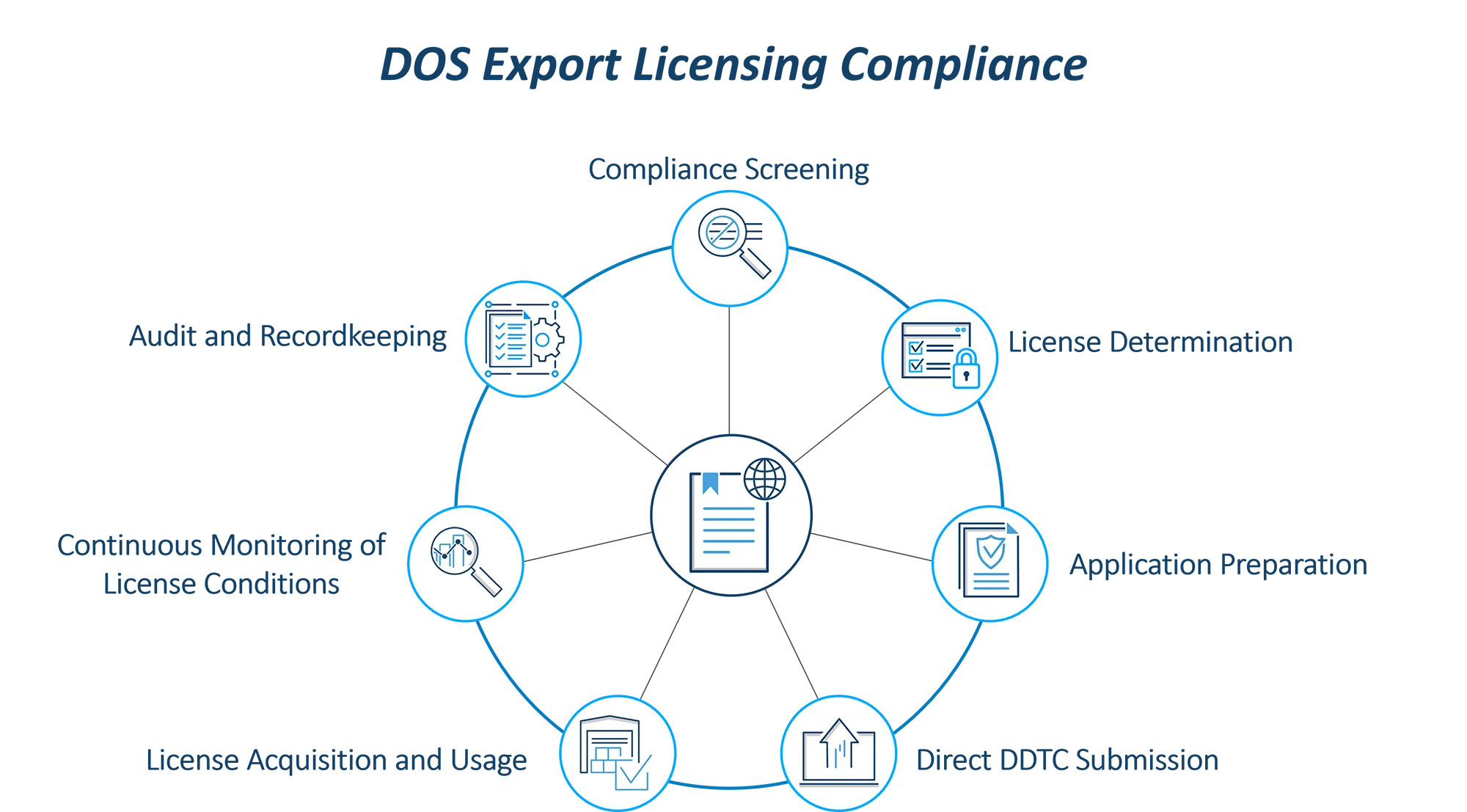
Before Applying to DDTC: Compliance Request Management and ITAR License Qualification
Before an application is submitted in DECCS, solutions like Descartes OCR Global EASE™ can help organizations accurately assess transactions, review jurisdiction, identify licensing requirements, evaluate risk factors, and standardize the collection of information needed for application preparation. Key capabilities:
- Request intake workflows
- Centralized storage of products, parties, and supporting documentation
- Watchlist screening integration
- Export classification and jurisdiction support
- Workflow routing and review processes
- Multi-entity collaboration across business units and subsidiaries
During DECCS Application: Direct ITAR Licensing Workflow Support
Export compliance software accelerates the preparation, submission, and management of DDTC license applications through capabilities such as:
- Configurable application templates that reduce preparation time and promote consistency across ITAR licensing activities
- Reusable records for prior authorizations that minimize duplicate data entry
- System-generated documentation and validation checks that help improve application quality and reduce submission errors
- Standardized workflows that align application preparation and approval activities with internal compliance policies
- Empowered Official review and approval workflows that maintain a record of ITAR licensing decisions
- Direct submission of ITAR license applications to DECCS without requiring users to manually re-enter information across systems
- Real-time application status tracking across submitted authorizations
- Automated notifications that help teams respond to RFIs, RWAs, approvals, and other export licensing events in a timely manner
- Centralized retention of ITAR license applications, supporting documentation, correspondence, and approval records
- Access to historical export licensing records that can support future applications, renewals, and amendments
Post-Approval: Control ITAR License and Authorization Use
Many of the highest-risk licensing activities occur after approval, when authorizations are actively being used to support exports, technical data transfers, and other controlled activities. Automation helps with:
- Monitoring of ITAR license expirations, review periods, proviso deadlines, and other time-sensitive compliance requirements
- Alerts for ITAR license exhaustion, low balances, and other utilization thresholds
- Real-time balance summaries that track remaining authorized values and quantities
- Automated decrementation and utilization tracking against export transactions and shipment activity
- Controls that can prevent or place holds on shipments when authorization limits have been exceeded or ITAR licensing conditions are not met
- Management of license provisos, approval conditions, reporting requirements, and associated compliance obligations
- Relationship tracking between export licenses, agreements, and amendments
- Recording and monitoring of technical data transfers and other activities supporting deemed export and defense service compliance
- Government reporting support and audit-ready records of authorization activity
- Advanced search, reporting, and document management capabilities that help teams locate ITAR compliance records as licensing activity scales
Best Practices for Managing ITAR Authorizations
Effective ITAR compliance programs typically focus on consistency, traceability, and process governance throughout the authorization lifecycle.
- Establish clear procedures for submitting licensing requests, collecting supporting information, and routing applications for internal review.
- Maintain a centralized repository for licenses, agreements, amendments, provisos, and supporting documentation. This reduces reliance on individual employees and simplifies audit, reporting, and renewal activities.
- Integrate ITAR licensing activities with watchlist screening, shipment, and export operations.
- Ensure changes to transaction details, suppliers, logistics providers, corporate structures, or participating parties
- Monitor amendment requirements, expiration dates, and renewal timelines proactively.
- Maintain audit-ready records throughout the authorization lifecycle.
Simplify ITAR License Management with Descartes OCR Global EASE
Descartes OCR Global EASE supports ITAR compliance throughout the authorization lifecycle, from the initial qualification of a transaction through application preparation, authorization management, and ongoing compliance activities.
Our comprehensive suite of global trade compliance solutions help organizations manage export license applications, approvals, documentation, submissions, and continuous ITAR license obligations on a single platform.
Book a demo to see how teams operating in manufacturing, aerospace, defense and other highly regulated sectors use Descartes to build complete and defensible ITAR license management programs.
Additionally, you can read this essential buyer’s guide to export license management software to help you select a solution that fits your needs.