Transportation management has become more critical with increasing cost pressures, rising customer expectations, and local and global disturbances happening every day. It is harder to manage and too expensive if you are still using disconnected tools and manual processes. That pressure is pushing logistics teams to look for better ways to lower freight spend and operational costs, enhance customer experience, and improve operations.
A TMS helps bring order to that complexity. The best systems do more than digitize freight tasks. They help transportation teams make better decisions.
This guide explains what a TMS is, its capabilities, the benefits shippers, 3PLs, and freight brokers can expect, its costs, and more.
Key Takeaways
→ A transportation management system helps businesses plan, execute, track, and improve freight movement across modes, carriers, and regions.
→ TMS software can reduce freight expenditure through better carrier selection, consolidation, freight audit, invoice validation, and stronger transportation planning.
→ Modern TMS platforms improve visibility, exception management, collaboration, customer communication, and operational efficiency.
→ AI is making TMS software more predictable and automated by helping teams anticipate disruptions and make smarter decisions.
→ The right TMS depends on the buyer’s operating model, freight complexity, integration needs, carrier network, and long-term transportation strategy.
What is a Transportation Management System?
A TMS solution helps companies plan, execute, track, and improve the movement of goods. For shippers, it becomes the operating system for transportation decisions: how freight should move, which carrier to use, what the expected cost is, where the shipment is, and whether performance is improving over time. For 3PLs and freight brokers, a TMS supports customer freight execution, carrier coordination, margin management, shipment visibility, and service performance.
More than simply a freight booking tool, strong TMS software helps companies manage transportation as a business process. It connects data like orders, shipment execution, and cost control in one workflow.
This connection matters because transportation decisions are rarely isolated. A carrier choice can affect delivery performance. A late pickup can affect customer service. A poor routing decision can increase cost. A lack of shipment visibility can create manual work across multiple teams. A TMS provides shippers with a more structured approach to handling these tradeoffs.
What Types of TMS Are There?
Not every TMS is built for the same type of organization or transportation operation. The right category depends on whether the buyer is a shipper, a logistics service provider, or has a hybrid operating model.
Consider the different types of solutions:
- A shipper TMS is designed for manufacturers, retailers, distributors, and wholesalers. This type of system is built around freight planning, carrier selection, execution, visibility, control, and performance improvement.
- A broker TMS is built for logistics service providers that manage freight on behalf of customers.
- A carrier or fleet TMS supports companies that operate transportation assets. The focus might include dispatch, driver management, and route execution, among other actions.
- A freight forwarder and 3PL/LSP TMS supports international freight movements that involve ocean, air, customs, documentation, and multi-leg coordination. These systems are often document-intensive and require strong connectivity with international logistics partners.
TMS software optimizes and automates your transportation workflows and can reduce your dependency, if needed, on outsourced transportation operations. This can be attractive to companies that want to be in control but also need additional operational resources or strategic transportation management support.
Given different TMS platforms solve different problems, companies need to start with their operational model. A shipper with complex multimodal freight, many carriers, and a need for network visibility will make a different choice than a broker managing margin per load or a fleet operator managing assets.
Key Benefits of Transportation Management Software
The business case for a TMS usually starts with freight cost reduction, but the value extends beyond transportation rates alone. A well-implemented TMS can also improve financial control, operational efficiency, and service reliability across the supply chain.
Key benefits include:
Freight savings
A TMS can help reduce freight spend by improving areas such as carrier selection, tendering, mode selection, and more. Instead of relying on manual lookups, teams can make transportation decisions based on real data.
Related features: carrier selection and tendering, consolidation and advanced planning, multimodal planning, freight audit and invoice validation.
Savings from consolidation and advanced planning
Freight savings often come from how shipments are planned before they move. A TMS can help identify consolidation opportunities, combine compatible orders, improve mode selection, and reduce unnecessary or inefficient moves. This is especially important for teams managing various locations, frequent shipments, or complex distribution networks.
Related features: consolidation and advanced planning, multimodal planning, carrier selection and tendering.
Freight audit and spend control
Freight audit is an important driver of savings because invoice errors, duplicate charges, or rate discrepancies can quietly increase transportation costs. A TMS can validate freight invoices against contracted rates, shipment details, and expected charges, giving finance and transportation teams better control over actual spend.
Related features: freight audit and invoice validation, cost allocation, analytics and reporting.
Reduced demurrage, detention, and accessorial costs
For some operations, demurrage, detention, and waiting time can significantly increase costs. A TMS can help reduce these costs by improving appointment coordination, shipment visibility, carrier communication, and exception management.
Related features: dock scheduling and appointment management, real-time visibility and exception management, carrier connectivity.
Improved visibility and control
Transportation teams need to know where shipments are, which loads are at risk, and what action is needed. Transportation visibility software helps teams monitor shipments, receive status updates, manage exceptions, and communicate more accurately with customers and internal stakeholders.
Related features: real-time visibility and exception management, carrier connectivity, analytics and reporting.
Greater operational efficiency
Manually managing transportation usually involves repetitive data entry, emails, calls, portal checks, and updating spreadsheets. A TMS can automate many tasks such as creating shipments, tendering, and communicating with carriers. This decrease in administrative workload enables teams to concentrate on exceptions and enhance processes.
Related features: carrier connectivity, carrier selection and tendering, automation, real-time visibility, and exception management.
Better customer service
Delivery performance is part of the customer experience. When shippers, brokers, and 3PLs can provide more accurate shipment information, respond faster to delays, and reduce missed or late deliveries, they improve customer confidence. For many organizations, transportation reliability directly supports customer retention and revenue growth.
Improved collaboration
Transportation depends on coordination between multiple parties in a business (e.g., procurement, customer service, warehouse operations). A TMS provides these parties with a more consistent process and shared information, reducing friction caused by disconnected systems and informal communication.
Enhanced sustainability Transportation is often the largest contributor to Scope 3 emissions for many companies. A TMS can help reduce unnecessary miles, support mode and load optimization, improve consolidation, and provide emissions measurement and reporting.
Main Features of a Modern TMS Platform
TMS solutions help manage transportation as an end-to-end process rather than as a collection of disconnected tasks. Capabilities that you can find in a TMS platform include:
- Multimodal planning: allows teams to evaluate different modes and service options. For shippers with varied freight profiles, multimodal support is essential because savings often come from choosing the right mode, not simply the lowest rate.
- Consolidation and advanced planning: helps identify opportunities to combine compatible orders, improve loading building, reduce partial shipments, and make better planning decisions before freight is tendered.
- Large existing carrier/forwarder network: enables automated communication between partners via Electronic Data Interchange (EDI), Application Programming Interfaces (APIs), portals, or network-based connectivity. This is a critical capability because transportation automation depends on the TMS's ability to exchange information with your carrier/forwarder network.
- Automated carrier selection and tendering/booking: helps determine which carrier should move the freight based on rates, service requirements, availability, performance, and business rules.
- Route optimization and carrier selection: helps determine how freight should move based on multiple data points such as cost, service, and capacity. This is where a TMS turns transportation data into decisions.
- Real-time visibility: track shipment status, identify delays, manage exceptions, and improve estimated arrival information. Visibility is more valuable when embedded in transportation workflows and a TMS rather than treated as a separate dashboard that teams must manually reconcile.
- Freight audit and payment capabilities: help validate invoices and reduce billing errors by giving finance and transportation teams a clearer view of actual transportation costs.
- Cost allocation: supports companies that need to allocate transportation costs by customer, business unit, product line, location, order, or cost center.
- Dock scheduling: coordinates pickup and delivery appointments at various points, which helps reduce congestion, improves labor planning, and lowers detention or waiting times.
- Analytics and reporting: turns transportation data into insight on spend, carrier performance, service levels, exceptions, lane performance, and continuous improvement opportunities.
The right TMS needs to be effective where the shipper’s transportation operation creates the most cost, complexity, and service risk.
How Is AI Changing Transportation Management Software?
AI is changing transportation management by helping teams move from reactive to more predictive, data-driven decision-making. A connected TMS gives organizations the real-time transportation data AI needs to identify patterns, anticipate disruptions, automate repetitive work, and support smarter planning. For shippers, brokers, and forwarders/3PLs, this can mean better visibility across shipments, faster exception management, and fewer errors.
The real value of AI in a TMS is not automation for its own sake. It is the ability to improve how transportation decisions are made across a complex, fast-paced network. When all the moving parts are connected (e.g., shipment data, carrier performance, rates), AI can help teams prioritize issues, improve collaboration, and enhance transportation performance. This transforms the TMS from a system that only helps manage freight activity into a platform that supports better judgment, stronger service, and more resilient operations.
TMS Pricing
TMS pricing depends on multiple factors. Modern TMS platforms are cloud-based, and recurring costs are often tied to usage.
A common model is price per shipment, which is attractive because the cost scales with transportation activity, and the per-shipment fee usually varies by volume, mode, and required functionality. Some vendors price by message, document, or transaction. That can look inexpensive at first, but the total cost can increase if each shipment generates many billable events.
Shippers should look carefully at what is included. Whilst some capabilities may be included by one provider, they might be treated as additional costs by another. For example, some traditional TMS providers lack a large carrier network and a real-time visibility module, which means they require one or even two additional parties and thus face costs to solve those gaps.
In addition to solution price, companies must also consider solution ROI. Organizations can often save 5% to 10% of their transportation budget with a TMS platform.
A realistic business case should include both savings and operational value. Savings might come from reduced freight spend, fewer invoice errors, and labor efficiency. Operational value may come from better customer communication, fewer delays, stronger carrier performance, and more reliable transportation data.
Estimate your Transportation Management System Investment
Indicate the number of shipments you execute per month for each transport mode.
Do I need a TMS?
If you’re asking this question, you’re not alone. Many businesses reach a tipping point where spreadsheets, emails, and manual processes just can’t keep up. Let’s dive into the challenges you might experience in your day-to-day operations and see if a TMS would create savings for your business.
How Long Does a TMS Implementation Take?
Implementation duration depends on scope. A focused rollout for a defined region, mode, or business unit can move faster than a global deployment with multiple integrations, complex carrier onboarding, and advanced workflows. A focused scope for a TMS implementation can be done in months, while a large global rollout may take more than a year.
The most successful implementations are not hurried into configuration. Instead, they begin with clear business objectives. From that point, the process becomes practical, involving tasks such as aligning stakeholders, configuring workflows, and connecting systems. A modern TMS is connected to your carriers to exchange bookings and information, and to track all shipments in real time. This requires a TMS that is part of a network of connected carriers/forwarders. Some TMS just offer an API, which puts the effort on your carriers/forwarders, who are often not willing or able to comply. In such cases, a TMS with a large network of carriers and forwarders already connected is preferred.
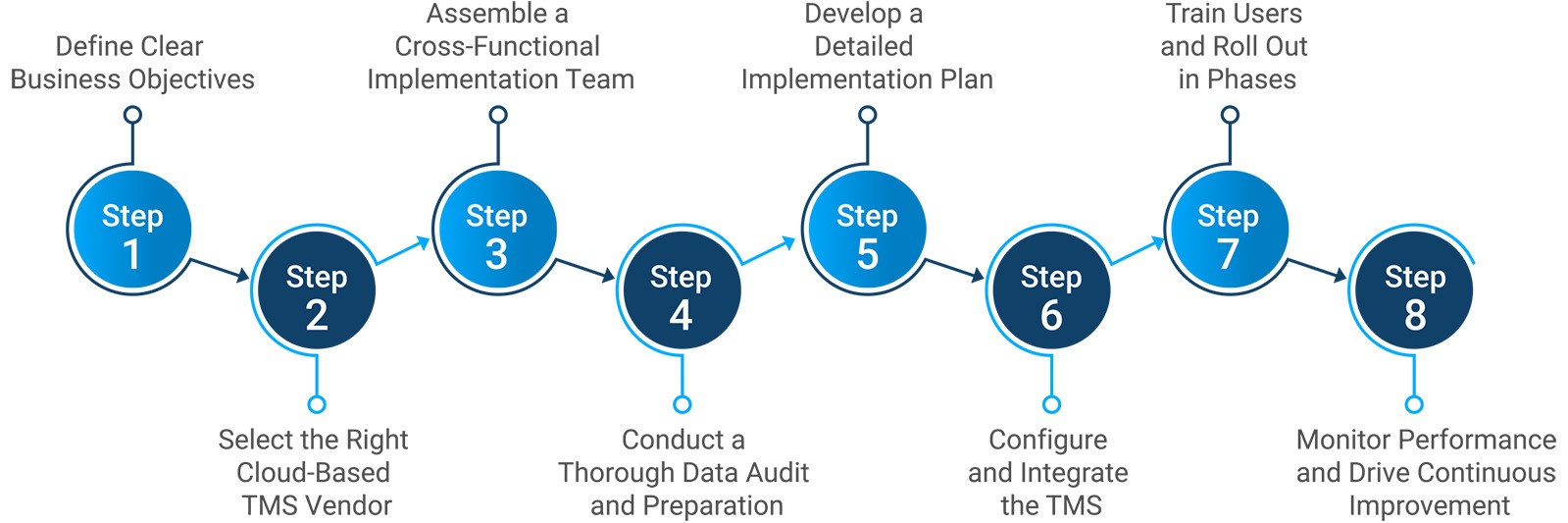
Check out our 8-step guide to a successful TMS implementation.
Because a TMS can affect both business performance and day-to-day collaboration, change management and clear ownership matter just as much as technical configuration.
How to Choose the Right TMS Provider
Are you searching for transportation visibility software? Freight management software for shippers? A platform for forwarder/3PL or broker operations? Or a broader transportation management environment that connects execution, visibility, analytics, and collaboration?
A TMS provider should be evaluated against the transportation strategy, not only against a feature checklist. The right partner should understand the modes, regions, carriers, service requirements, and operational realities of the business.
Shippers should ask whether the provider can properly support all transport modes in scope and potential future developments. A company that expects to expand internationally, add parcel, or increase visibility should understand whether those capabilities are native, integrated, or dependent on third-party tools.
Support and implementation also matter. TMS projects often fail to reach their full value because the implementation partner is not an expert in the chosen TMS, which can result in TMS software that is technically live but poorly adopted and not covering key complex scenarios. The TMS provider should be able to configure the TMS to cover complex scenarios, guide data preparation, carrier onboarding, integrations, and continuous improvement after go-live.
TMS Solutions
A useful provider comparison recognizes that not all vendors compete in the same way. Some excel in shipper settings while others are tailored for brokers or forwarders/3PLs. A modern and complete TMS includes a network and real-time visibility, whereas others are more oriented to be used standalone and require the users to do manual bookings, ask another provider to fill those gaps, or manage the integrations with third parties themselves. Additionally, a TMS often also varies in the level of complexity and types of transport modes it can support effectively.
Below is a comparison table of various TMS solutions. Source: G2's best transportation management systems (TMS)
| Solution | Market Position | Common Fit | Evaluation Notes |
| Descartes Shipper TMS | Shipper-focused transportation management | Medium and high-volume shippers managing multimodal transportation | Strong fit where complex planning, carrier connectivity, multimodal execution, visibility, and logistics network reach are priorities |
| Descartes LSP/3PL TMS | Broker and 3PL transportation management | Freight brokers and logistics service providers | Often evaluated by 3PLs and brokers that need operational workflows and shipment management |
| Oracle Transportation Management Cloud | Enterprise TMS | Large and complex enterprises | Often considered by organizations with an existing broader Oracle environment but does not include a large carrier network or real-time visibility module. |
| SAP Transportation Management | ERP-centric enterprise TMS | SAP-centered organizations | Often evaluated when transportation workflows are not complex and multimodal, and integration with third parties is less important |
| Trimble TMS | Transportation and carrier-oriented operations | Carriers, fleets, and transportation businesses | Often relevant where fleet, dispatch, and transportation operations are central |
| Freightview | Cloud TMS for shippers | Small and mid-sized shippers, especially LTL-focused operations | Often evaluated for ease of use, quoting, rating, and shipment visibility |
| Descartes Aljex | Broker and 3PL transportation management | Freight brokers, 3PLs, and logistics service providers | Often evaluated by brokers and 3PLs that need transportation management workflows, shipment execution, carrier connectivity, and operational visibility |
| GoComet | Visibility and transportation automation | Global logistics teams and shippers | Often evaluated for visibility, automation, and international shipment workflows |
| project44 | Transportation visibility | Enterprises needing shipment visibility across networks | Often considered where real-time visibility and predictive transportation insights are key priorities |
| Gnosis Freight | Container lifecycle and visibility | Ocean freight and containerized supply chains | Often evaluated by companies needing container visibility and lifecycle management |
| ShipperGuide TMS | Shipper transportation management | Mid-market shippers and freight teams | Often considered for planning, execution, tracking, and analytics workflows |
| Pando | Freight management and execution | Enterprise and mid-market supply chains | Often evaluated for route planning, load consolidation, and execution efficiency |
How Does Descartes Fit into the Market?
Descartes fits into the market with a broader TMS solution for shippers, brokers and 3PLs. Its transportation management capabilities span multimodal planning and execution, real-time shipment visibility, dock appointment scheduling, collaboration portals and APIs, carrier management, analytics, and reporting.
Descartes is a strong fit where transportation teams need to manage large, multimodal operations, improve carrier connectivity, increase visibility, and support better planning and execution across regions and networks.
A transportation management system is not just a logistics tool. For transportation teams in logistics-intensive businesses, it is a way to bring more discipline, visibility, and intelligence to one of the most complex parts of the supply chain.
The right TMS helps companies make better freight decisions, reduce freight spend, automate operational activities, and improve service. The best solution will depend on the organization’s transportation profile, network complexity, integration needs, and long-term strategy.
For buyers, the smartest path is to start with the business problem: transportation that is too costly, too slow, too manual, or limiting service performance. The TMS decision should follow that.
Descartes has been named the top provider of cloud-based TMS solutions and top fleet management provider in ARC Advisory Group’s 2025 Transportation Management Global Report

Would you like to learn more about Descartes Transportation Management solutions?
Relevant Resources

TMS Buyer's Guide
TM Benchmark Survey