Guide for a TMS implementation
A Transportation Management System (TMS) is a critical tool for modern logistics operations. Cloud-based TMS solutions are gaining traction for their scalability, accessibility, and lower upfront costs. But to realize the full benefits such as streamlined operations, reduced freight spend, and end-to-end visibility, the implementation must be done right.
This guide takes you through the 8 key steps for a successful cloud-based TMS implementation, specifically for shippers, that automates the processes to plan, execute, and optimize the physical movement of incoming and outgoing goods, as well as the communications and documents that enable that movement.
8 Steps to a successful TMS implementation
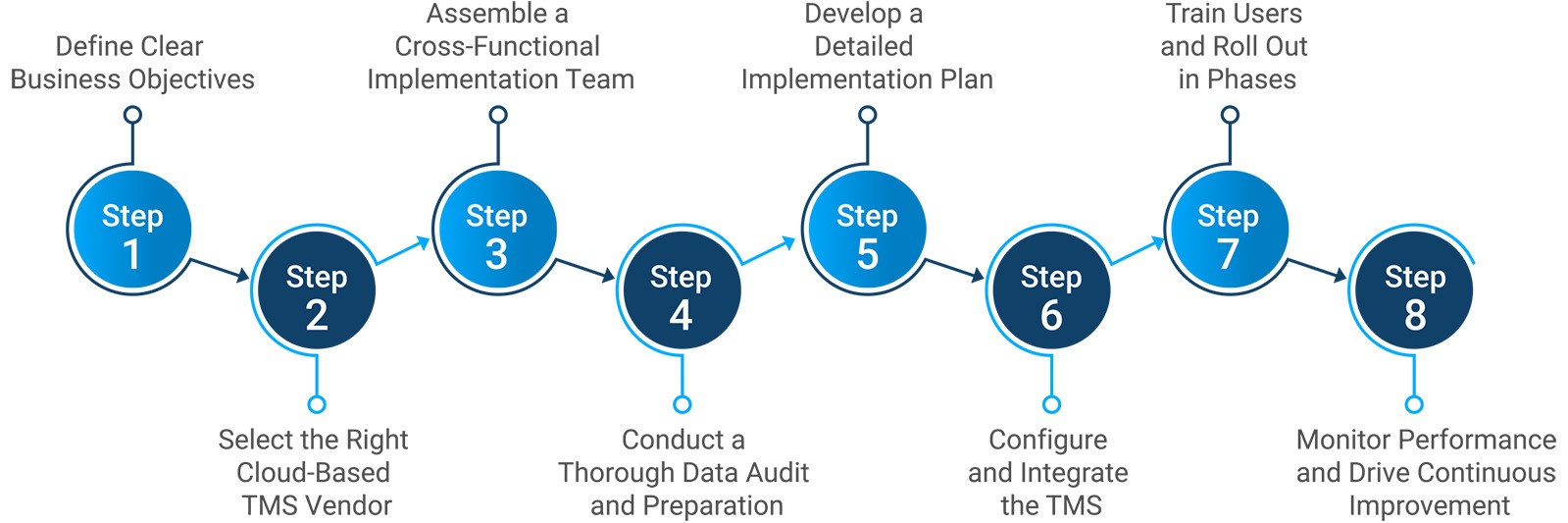
Start by identifying your organization’s pain points and goals, such as reducing transportation costs (e.g., “reduce freight costs by 10% in 12 months”), increasing shipment visibility, or automating manual processes. Ensure that the TMS capabilities align with your strategic logistics and supply chain objectives.
A well-implemented TMS can significantly enhance supply chain efficiency, reduce operational costs, increase customer service efficiency and provide greater control and transparency across logistics operations.
The differences between TMS vendors aren’t just in the software and price, but also in how strong the support teams are and how well-known and trusted the company is. Evaluate vendors based on:
- Scalability and ability to support future growth
- Integration capabilities with your existing systems
- Right balance between standard workflows and specific processes
- User experience and interface design
- Customer support and implementation expertise
Consider your industry-specific needs and future growth plans. Review vendor reputation and customer success stories to make an informed, future-proof decision.
Form a team that includes representatives from IT, logistics, customer service, procurement, finance, and other impacted departments. Assign clear roles and responsibilities, and establish communication protocols early.
Secure executive sponsorship to drive alignment and resources allocation. Include change champions to support adoption and develop a robust internal communication and change management plan - a critical but often overlooked success factor. Appoint the key users, train them well as they are the first reference point to drive further optimization or changes.
Cleanse, validate and standardize key data sets such as carrier rates, customer profiles, and shipment history. Map out data flows and identify integration points with your Enterprise Resource Planning (ERP), Warehouse Management System (WMS) and other business platforms.
Plan for data migration and conduct rigorous testing to ensure accuracy. Remember, data quality is an ongoing responsibility. Establish data governance practices and monitoring mechanisms to maintain integrity post-implementation.
Create a structured plan with timeline, milestones and deliverables to track progress and maintain stakeholder engagement. Conduct a risk assessment and define mitigation strategies.
Include change management and training plans to ensure user adoption. Your vendor’s implementation team should take the time to fully understand your current business processes and systems - including manual tasks, emails, and phone calls - that the TMS will either replace or improve. It’s important to remember that a TMS shouldn’t just copy what you’re doing now. Instead, this is a chance to reimagine and optimize workflows and strategies.
A strong implementation partner will guide you through these decisions, helping you unlock the true potential of the TMS.
Begin by aligning expectations: the TMS vendor presents their standard workflows, while you provide a detailed overview of your internal processes. The objective is to co-create a Proof of Concept (PoC) based on the vendor’s standard flow, ensuring it aligns with your operational needs.
Once the solution design is approved, the vendor proceeds with the configuration and customization phase, addressing any non-standard requirements. Following this, collaborate closely to integrate the TMS with your existing systems such as an ERP.
Ensure comprehensive testing of all integrations in a sandbox environment to validate data flows, system behavior, and end-to-end functionality before moving to production.
Deliver role-specific training supported by clear, accessible documentation. Start with a pilot rollout in a selected region or business unit to validate the solution in a real-world setting.
Gather feedback from pilot users, address any issues, and refine the setup. Once stabilized, proceed with a phased rollout across the organization to minimize disruption and ensure adoption.
Define and track key performance indicators (KPIs) such as on-time delivery and freight cost per unit. Leverage analytics and reporting tools to monitor performance in real time.
Establish a cadence for regular reviews to identify improvement opportunities. Use insights to fine-tune workflows, enhance user experience, and ensure the TMS continues to deliver value as business needs evolve.
Conclusion
Successfully implementing a cloud-based Transportation Management System is not just a technology upgrade. It’s a strategic transformation. By following these eight steps, organizations can lay a strong foundation for long-term logistics excellence. From setting clear objectives and choosing the right vendor to continuous optimization, each phase plays a critical role in unlocking the full potential of a TMS.
A well-executed implementation empowers shippers to streamline operations, gain real-time visibility, and make data-driven decisions that drive efficiency and cost savings. Most importantly, it positions your supply chain to be more agile, resilient, and competitive in an increasingly complex logistics landscape. With the right approach and commitment, your TMS journey can become a powerful catalyst for operational success and growth.

Transportation management Resource Center
Explore insights and resources to optimize your transportation operations and empower your supply chain

Customer Success
See how we empower our customers to succeed with Transportation Management

TMS - FAQ
For more details on what a TMS is check out our FAQ here

Transportation Management Solutions
Global Transportation Technology to Strengthen Your Supply Chain