Freight Forwarders and the Rising Tide of Regulation: Navigating Complexity in Global Trade
Long defined by constant change, the logistics industry faced unprecedented regulatory and compliance challenges in 2025. According to the 2025 Descartes Forwarder & Broker Benchmark Study, forwarders and customs brokers are navigating a business environment defined by tariff uncertainty, trade volatility, and mounting compliance costs, while also striving to modernize through technology.
The study, which surveyed 434 logistics professionals across North America, EMEA, Asia-Pacific, and Latin America, reveals that while most forwarders remain optimistic about the future, many are struggling to balance near-term regulatory pressures with long-term digital transformation goals.
Rich Automation Capabilities
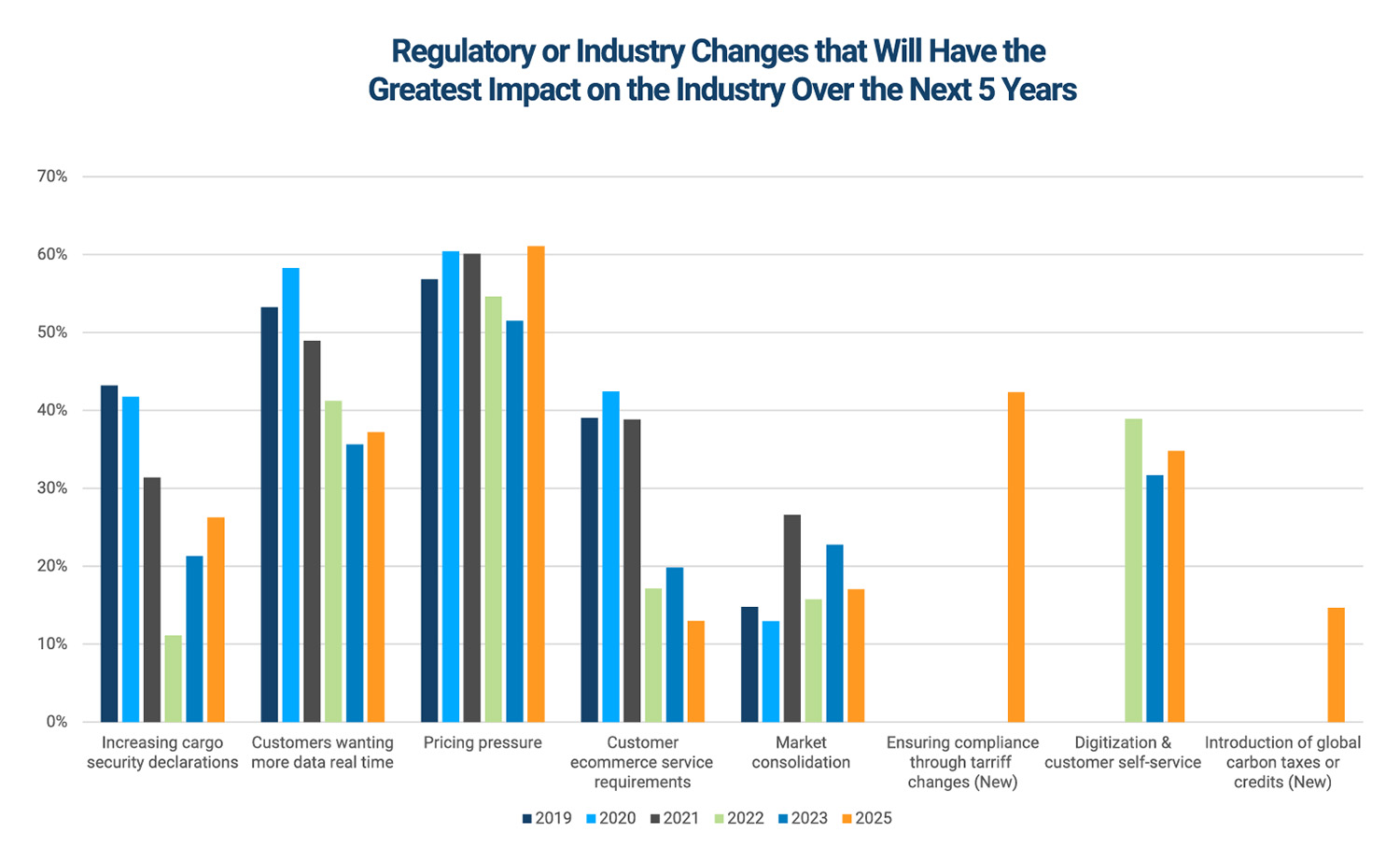
The survey shows that compliance and cost management are now the leading industry concerns. When asked which changes will have the greatest impact on their business over the next five years, respondents ranked pricing pressure (61%), tariff compliance (42%), and digital customer expectations (35%) among their top challenges.
This signals a clear trend that forwarders are caught between a tightening web of regulatory requirements and customer demands to deliver faster, more transparent service. Compounding these challenges, tariff volatility and regional trade policy shifts have introduced new levels of uncertainty. Many respondents noted that “ensuring compliance through tariff changes” is one of the most significant concerns for the next five years — a direct reflection of fluctuating U.S. and global trade practices.
Compliance as a Strategic Imperative
Compliance has evolved from a back-office function into a strategic differentiator. The study found that 30% of respondents, and fully 50% of large companies, view technology as fundamental to regulatory compliance, while another 32% call it highly important.
This shift underscores how digital tools are now essential for managing the pace and complexity of global regulations, from tariffs and customs filings to denied party screening. Yet despite recognizing its importance, many organizations still lag in implementation.
Technology’s Role in Compliance Agility
The study highlights a growing gap between technological aspiration and execution. Forwarders overwhelmingly agree on the importance of automation, analytics, and artificial intelligence (AI), but many continue to rely on manual processes that limit their ability to scale their compliance operations. In fact, 25% of respondents identified manual workflows as their top growth inhibitor, followed by IT competency/resource constraints (20%). To close this gap, forwarders are beginning to turn to technology-driven compliance systems capable of dynamically managing tariff changes, filing requirements, and audit documentation.
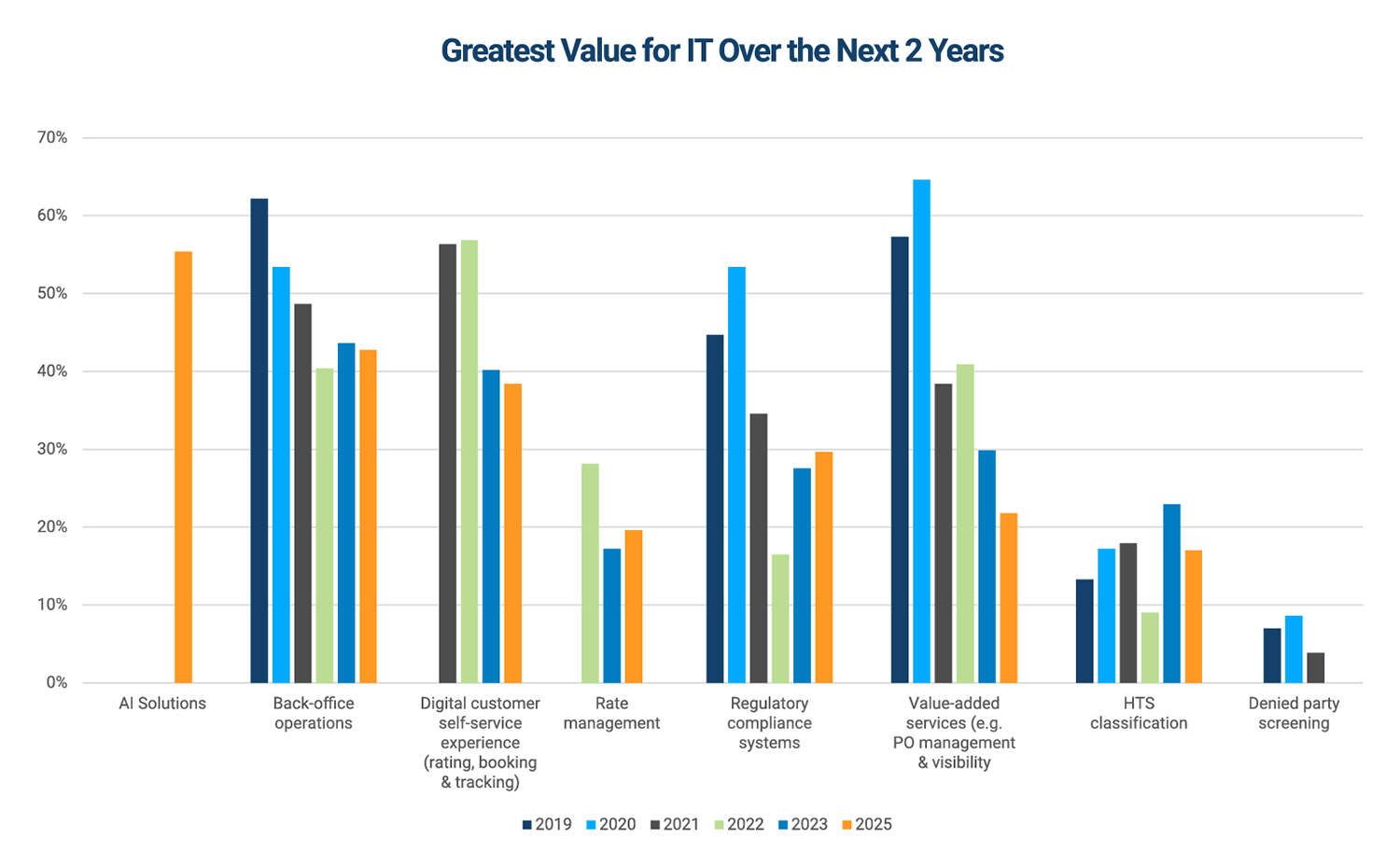
The study also shows that AI now represents the top planned IT investment area, with 55% of respondents prioritizing AI development for the next two years, followed by regulatory compliance systems (30%). This reinforces the idea that automation is no longer a “nice-to-have,” but the foundation for long-term compliance agility.
The Compliance Divide: Thrivers vs. Survivors
The 2025 Benchmark Study segments respondents into two financial performance groups — “Thrivers” (those with profit margins above 11%) and “Survivors” (those breaking even or operating at tighter margins). While these groups differ in their current strategies, the findings reveal significant opportunity for evolution across the industry. Thrivers are already seeing results from investments in technology, automation, and AI-driven compliance processes, while many Survivors are beginning to explore how these same tools can help them improve efficiency, control costs, and strengthen resilience.
Conclusion: Compliance as a Catalyst for Transformation
The 2025 Descartes Forwarder & Broker Benchmark Study makes one thing clear: the future of freight forwarding will be defined not by who can move goods fastest, but by who can adapt most effectively to regulatory change. In an era of tariffs, sustainability mandates, and evolving trade agreements, compliance isn’t just about meeting requirements, it’s about building trust, resilience, and competitive advantage.
By embracing automation, analytics, and technology-driven compliance, forwarders can move beyond reacting to regulation and start leading with innovation.
How Descartes Helps Forwarders Stay Ahead of Regulatory Change
With more than 30 years of industry experience, Descartes helps forwarders and brokers streamline compliance, manage risk, and optimize operations. Our integrated platform delivers:
- Automated customs filings and duty management
- Visibility across global supply chains and regulatory jurisdictions
- Audit-ready documentation and recordkeeping
- Checks to ensure a fast and error-free Customs filing