ERP Integrated EDI
Discover the power of integrating EDI with your ERP systems
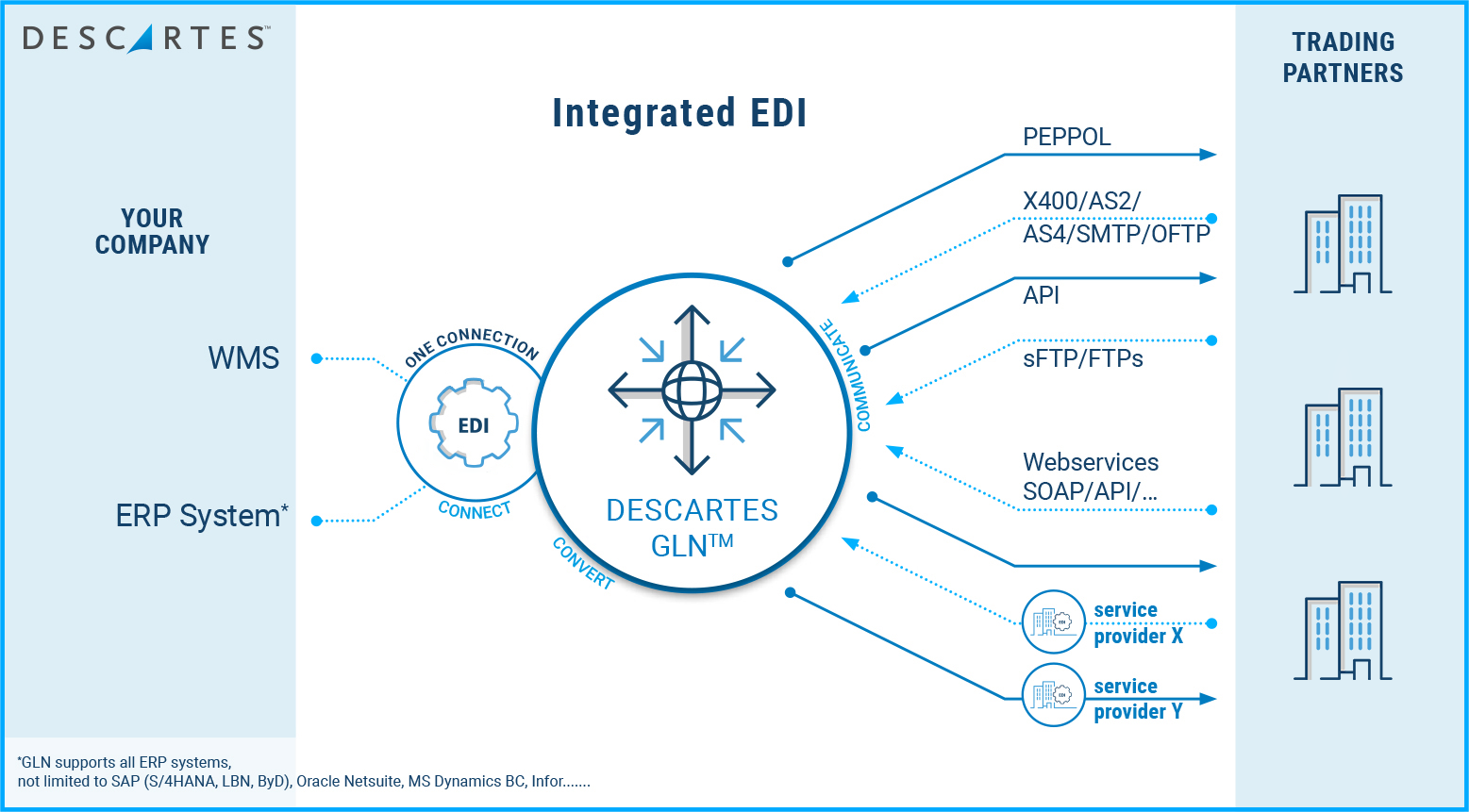
Descartes offers robust integrated Electronic Data Interchange (EDI) solutions that enhance connectivity, automate data exchange, and optimize business operations













Comprehensive EDI integration with your ERP system tailored to your needs
The Descartes EDI solution seamlessly integrates with ERP systems, offering standardized document exchange, data translation, compliance management, and 24/7 support for uninterrupted business communication.
Key Features of the Descartes Integrated EDI Solution
ERP Integration

Secure platform

Connectivity
Communication Protocols
Supported Message Formats

Service Desk
Would you like to find out more about our integrated EDI solutions?
Benefits of integrating EDI with your ERP
Whether you are a local enterprise or a global corporation, our solutions ensure seamless integration and efficient data management.

Increased efficiency
Cost savings

Data accuracy

Customer satisfaction

Sustainability
Descartes is the market leader for EDI integration solutions
Explore the latest EDI strategies, tactics and insights.

Descartes Integrated EDI Solution
Our Customers Achieve Remarkable Successes
“97% of all our messages are sent via EDI. In just three months, almost all of our suppliers successfully connected to the new EDI solution to enable message exchange.”

Pieter Datema, Application Manager

"Thanks to Descartes’ integrated EDI solution, we can automate our processes and eliminate media disruptions. With high-quality data at a superior level, we have become faster and more efficient across the board."

Rita Hochstrasser, System Integrations
Action Guide
Six steps for a successful EDI Implementation
The secret of success lies in going through the various steps in order to ultimately use all the benefits of EDI in your day-to-day business. Based on our experience with customers, we have established the six steps for a successful EDI implementation.
Read our EDI FAQ
Companies can save time and costs by no longer having to retype data, thus avoiding errors. An optimal EDI connection will help improve customer service. Suppliers who use EDI have a stronger competitive position compared to peers who have not yet adopted EDI. Finally, the use of paper can be greatly reduced or even eliminated.
An EDI service provider is a service provider that sells the software and tools to exchange EDI, but also offers additional EDI services such as mapping or translation services to get messages into the right formats; or archiving of the messages. In addition, the EDI service provider also provides the platform or network on used to exchange EDI messages and will monitor the smooth exchange of messages 24/7.
The communication protocol is going to determine the way the connection is set up to exchange EDI messages. The most commonly used protocols are AS2, SFTP, HTTPS and APIs.
EDI solutions are available in different types depending on a company's EDI adoption rate. For companies that were not yet doing EDI and want to start with it, WebEDI is an ideal entry-level solution. Companies that exchange a lot of EDI are more likely to choose an integrated solution with their ERP, whether or not fully outsourced to an EDI service provider.
Many industries have their own standards, which were agreed upon and accepted internationally. For example, in retail and in Healthcare the GS1 standard is used, in the automotive industry the standard is determined by ODETTE, in air cargo it is IATA.
Once you have determined the standard you will use, you need to check if your system can handle this standard. If not, you can use message mappings to ensure the standard will work with your internal systems.
EDI can be used in all industries. We see that in some industries the use of EDI has been given an extra boost by standardization organizations, for example GS1 in retail and IATA in the air industry. Sometimes companies will also require their suppliers to engage in EDI. In addition, there are quite a few government agencies such as customs and port authorities that require declarations to be sent electronically via EDI.
Industries where there is a high EDI adoption rate include retail, eCommerce, manufacturing and distribution, logistics, etc.
API stands for Application Programming Interface and is the collection of ways a computer program can communicate with another program. It is a powerful tool for synchronizing web and Cloud SaaS applications, which adds new capabilities and possibilities to the traditional electronic data interchange.
Real-time synchronous connections can handle data transfer in less than a second and take care of multiple requests in both directions at the same time. By enabling this level of automation companies can increase their efficiency and improve response time to customers, resulting in more sales and better customer service.
Descartes can help set up your API connectivity so you can integrate with marketplaces such as Amazon and bol.com: Connecting to online marketplaces via API allows companies to automatically exchange data on listings, orders, payments, reports, and more in real-time.
Featured Content

Is EDI still relevant?