
Addressing Forced Labor Risks with Trade Compliance Software
Forced labor remains one of the most pressing challenges in today’s global supply chains, drawing heightened scrutiny from regulators, customers, and stakeholders alike. What was once a peripheral concern has now become a key trade compliance issue, with significant legal and reputational risks for companies that fall short.
The Uyghur Forced Labor Prevention Act (UFLPA) has intensified enforcement in the United States, resulting in more detentions, investigations, and penalties tied to supply chain violations. At the same time, other jurisdictions—including the United Kingdom and Canada—are advancing their own forced labor due diligence laws, signaling a global shift toward stricter accountability.
In this evolving landscape, organizations can no longer rely on manual processes or surface-level checks. To mitigate risk and maintain compliance, companies must level up their compliance tools, leveraging trade compliance software to strengthen due diligence and safeguard supply chain integrity.
Key Takeaways
- Forced labor has become a critical compliance issue in global supply chains requiring proper due diligence.
- UFLPA detentions and import denials in 2025 surged especially in the automotive and aerospace industry, which accounted for 83% of all goods stopped and inspected for forced labor risks.
- Multiple global jurisdictions are shifting toward mandatory, rather than voluntary anti-forced labor frameworks
- Tier 1 suppliers may appear compliant, but enforcement is digging deeper.
- Without trade compliance software, forced labor risks are extremely hard to detect. Solutions like those from Descartes provide the visibility and intelligence businesses need to uncover hidden exposure and maintain compliance.
Lessons Learned After 40 Months of UFLPA Enforcement
The US State Department describes the UFLPA as “one tool the US government uses to prevent goods made with forced labor connected to the Xinjiang Uyghur Autonomous Region (XUAR) from entering the United States.” The UFLPA, enacted in June 2022, places the burden of proof on importers, who must conclusively demonstrate that no forced labor was involved in producing their imported goods or components.
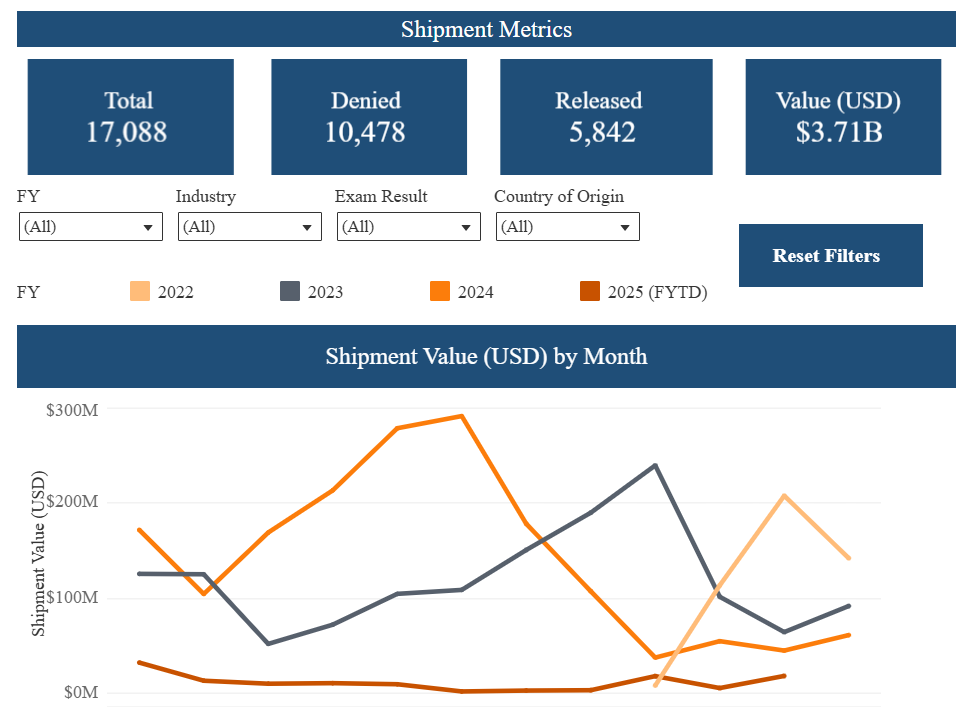
As of the third quarter of 2025, US Customs and Border Protection (CBP) statistics revealed over 17,000 detentions valued at nearly $4 billion since the Act’s inception, with detention rates spiking significantly in recent months. The following charts show not just the enforcement record, but also the trajectory.
The data points to a future where forced labor compliance obligations will continue to rise across industries and supply chains.
Industries Most Impacted by UFLPA Detentions
The automotive, aerospace, and electronics industries have been the most heavily impacted to date, accounting for well over half of all detained shipments.
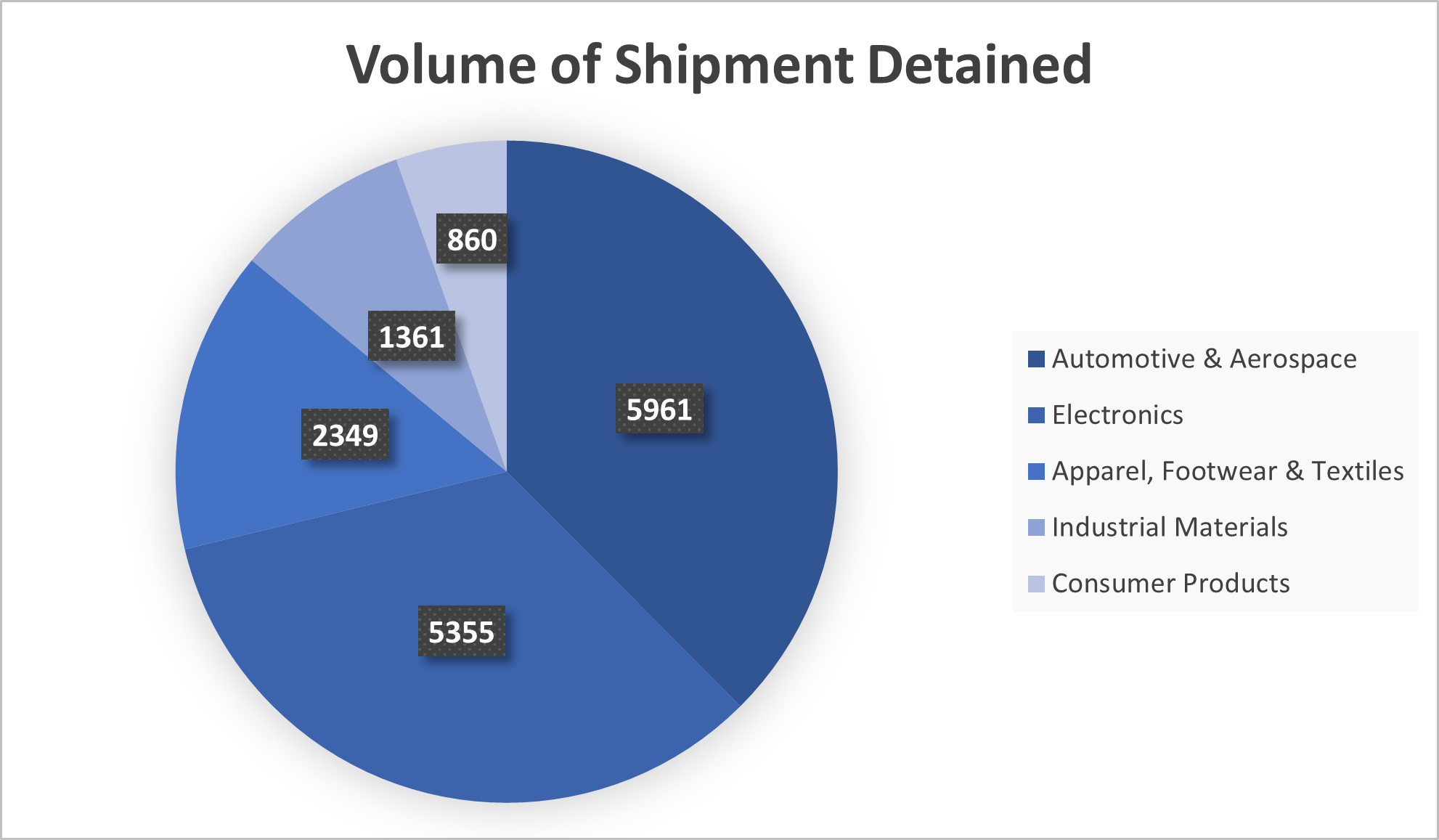
Other affected industries include:
- Agricultural Products: 690 detentions
- Metals: 466 detentions
- Pharmaceuticals and Chemicals: 365 detentions
- Machinery: 275 detentions
Leading Countries for Detained Shipments
The largest value of detained goods doesn’t always trace back to China. Instead, many originate from intermediary hubs like Malaysia, Vietnam, and Thailand, where manufacturers often source raw materials or components linked to XUAR. This multi-country sourcing and opaque sub-tier networks create one of the toughest trade compliance challenges: forced labor risks hidden deep in tiered supply chains.
Detained Shipment Value by Country
| Country | Shipment Value (USD) |
| Malaysia | $1.55B |
| Vietnam | $1.02B |
| Thailand | $0.53B |
| China | $0.44B |
| All Other | $0.11B |
| India | $68.53M |
Share of Shipments Released vs. Denied
Since its inception, 61% of all shipments detained under UFLPA have been denied. This can result in the CBP issuing an exclusion notice, potential seizure and forfeiture of the shipment, and the possibility of fines.
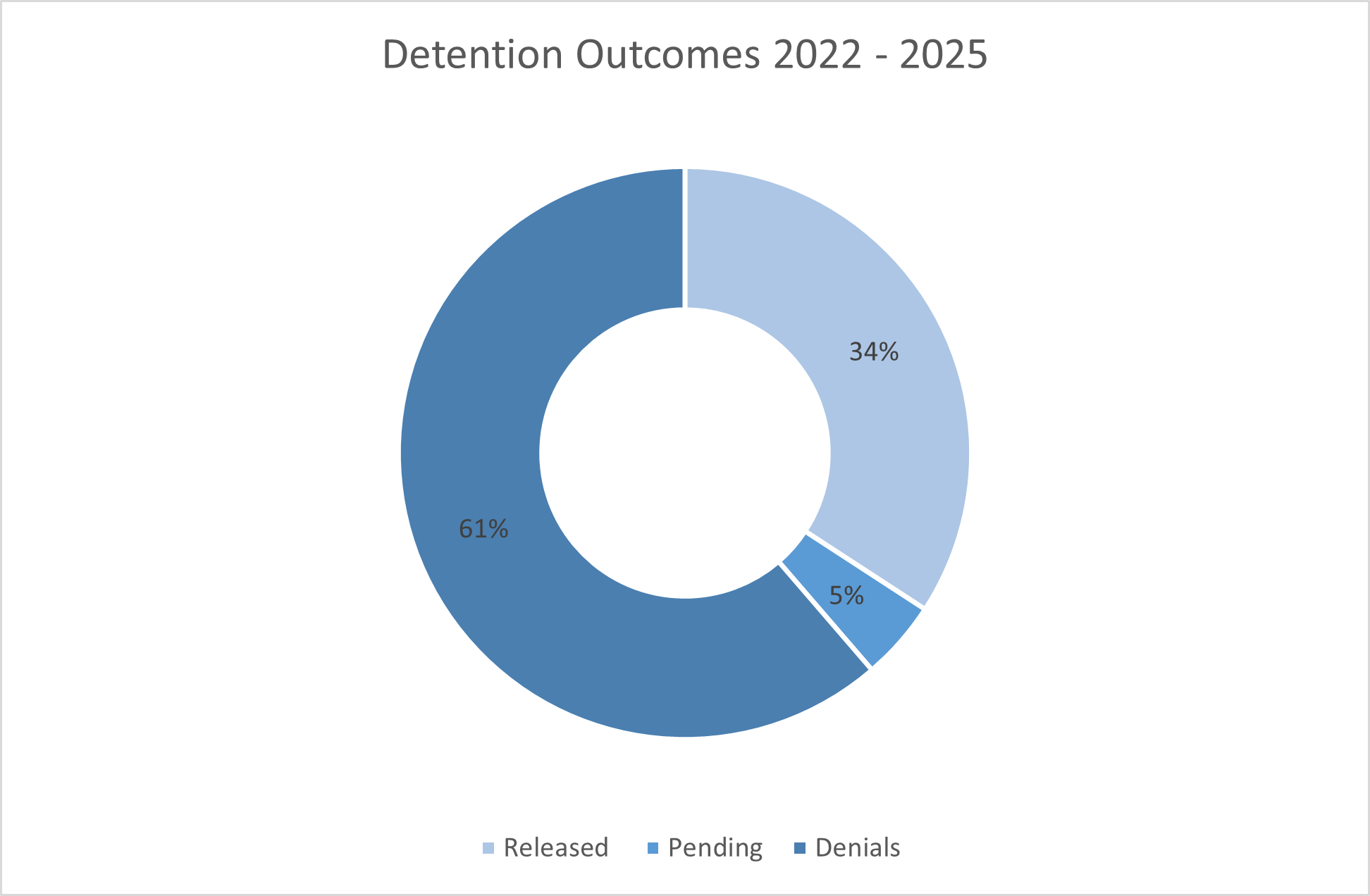
The majority of UFLPA entry denials were issued in 2025, a significant increase compared to previous years. This marks a tightening of the enforcement threshold, with CBP requiring far more granular, verifiable documentation to rebut the presumption of forced labor.
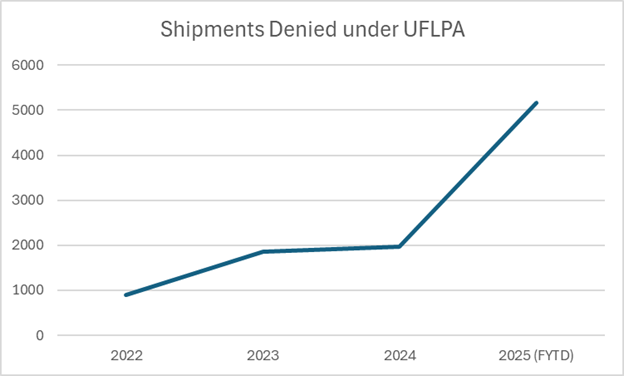
This rising trend underscores the importance of a proactive trade compliance strategy that includes: UFLPA entity list screening, traceability, and audit readiness embedded across procurement, logistics, and legal functions, rather than being handled reactively after detainment.
Forced Labor Risk Spotlight: Automotive Industry Under Scrutiny
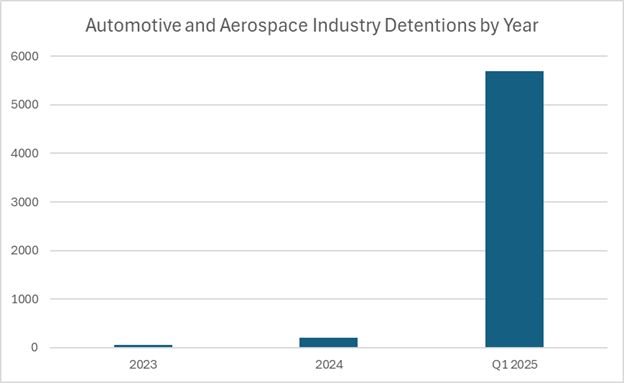
The automotive industry is under growing pressure from UFLPA enforcement. Once considered a secondary concern, the sector now leads in both shipment volume and value detained. The jump in 2025 is staggering, with the Automotive and Aerospace industries rising from a combined total of 246 detentions in the previous two years to 5,713 by September 2025.
What makes automotive supply chains so risky?
- High-Risk Components: The biennial Trafficking Victims Protection Reauthorization Act (TVPRA) list highlights that common imports such as aluminum, steel, batteries, semiconductors, and wiring harnesses all require inputs frequently tied to Xinjiang or restricted entities.
- Deep-Tier Risk: Original Equipment Manufacturers (OEMs) often lack visibility beyond Tier 1 suppliers. However, UFLPA enforcement now extends to Tier 2 and 3 subcontractors and raw material processors. OEMs must conduct due diligence and require supply chain compliance software to document it.
- UFLPA Compliance Exposure: Failing to identify and block restricted entities exposes companies to import holds, fines, and reputational fallout.
Global Perspectives on Forced Labor Regulation
Regulatory frameworks are tightening globally, marking a definitive shift from voluntary measures toward compulsory forced labor compliance.
- UK Modern Slavery Act: In effect since 2015, the Modern Slavery Act currently requires companies with over £36 million in revenue to publish an annual statement on transparency in supply chains. In mid-July, the UK Parliament’s Human Rights Committee published a report pushing for more rigorous supply chain due diligence requirements, extending the Act’s scope to include more organizations and introduce penalties for noncompliance.
- Canada's S-211 Act (2024): Canada’s S-211 Act, effective January 1, 2024, requires Canadian and foreign entities with significant operations to publicly report measures taken to prevent forced and child labor in their supply chains. Reports must detail policies, risk assessments, and remediation steps, be approved by the governing body, submitted annually to the Minister of Public Safety by May 31, and published on company websites. Non-compliance can result in fines up to $250,000.
- Germany’s Supply Chain Due Diligence Act (LkSG): In force since January 1, 2023, requires companies with 1,000+ employees (3,000 in 2023) to manage human rights and environmental risks across their supply chains. Obligations include risk analysis, preventive and remedial measures, a complaints mechanism, and annual public reporting. Non-compliance can lead to fines up to 2% of global turnover.
- EU’s Corporate Sustainability Due Diligence Directive (CSDDD): Introduced in July 2025, the CSDDD obligates businesses to perform due diligence across global value chains, with civil liabilities for harms caused by noncompliance. The global legal landscape now demands thorough, verifiable supply chain due diligence, requiring advanced digital compliance solutions to avoid hefty penalties.
How Trade Compliance Software Helps Mitigate Forced Labor Risk
Advanced supply chain and trade compliance software is essential for navigating this rigorous regulatory environment. Here’s how it helps businesses stay ahead of forced labor risks:
Automated Supplier Screening
Robust compliance platforms continuously scan and flag high-risk suppliers and sanctioned entities against updated databases. This eliminates manual checks, providing automated, accurate risk assessments before placing orders.
Best Practice: Integrate restricted party screening with your procurement processes, ensuring prohibited entities never enter your supply chain.
Multi-tier Traceability and Visibility
Today’s compliance tools visualize supply chain connections across multiple tiers, identifying hidden forced labor risks among sub-tier suppliers. Companies gain insights into the ownership and origin of components, enabling proactive mitigation.
Comprehensive Audit Trails and Documentation
Digital platforms consolidate compliance documents and traceability records, ensuring rapid response to regulatory inquiries. Documentation such as origin certifications, due diligence reports, and shipping records are centrally maintained, enabling companies to swiftly defend against forced labor allegations, rebut UFLPA presumptions and comply with global audit demands.
Ongoing Regulatory Compliance Monitoring
Forced labor regulations evolve constantly. Compliance platforms automatically update in line with global regulatory changes, ensuring continuous alignment across jurisdictions. Leverage trade compliance tools with dynamic rescreening capabilities, updating automatically whenever entities are added to global watchlists.
Educate Cross-Functional Teams
Modern trade compliance software also serves as an educational tool. By sharing real-time compliance data across procurement, logistics, legal, and sustainability departments, companies ensure better-informed decision making and quicker responses to compliance threats. Choose platforms offering built-in training modules and streamlined compliance workflows.
Manage UFLPA and Global Forced Labor Compliance with Descartes
Forced labor enforcement isn't just intensifying; it's now a core compliance requirement. Relying on outdated processes risks costly detentions and reputational damage. Leading companies are moving to automated solutions for visibility, traceability, and defensible documentation.
Descartes offers comprehensive global trade compliance solutions including robust third-party risk management tools, product classification, and export compliance software that provide the insights and capabilities to build safe and sustainable supply chains.
Don’t wait for enforcement to expose the gap—transform forced labor compliance now with Descartes. Request a demo.
Find out what our customers are saying about Descartes Restricted Party Screening on G2 – an online third-party business software review platform. Additionally, you can read this essential buyer’s guide to denied party screening to help you select a solution that fits your needs.