
Office of Foreign Assets Control (OFAC) screening is a critical safeguard for businesses engaged in cross-border trade. It helps ensure compliance with U.S. sanctions laws by flagging transactions and entities that may be linked to prohibited parties. But when your OFAC sanctions screening software starts incorrectly flagging legitimate clients and transactions, you’ve got more than a minor inconvenience—you’ve got a major operational risk.
False positives aren’t just annoying. They cost time, money, and your company’s reputation. Every incorrectly flagged alert forces your compliance team to pause their workflow and manually verify that a harmless entity isn’t secretly on a restricted or denied party list. This constant interruption not only drains resources but also risks placing your business on the wrong side of regulatory compliance. The ripple effect across your operations can be substantial.
In light of these risks, how can your business reduce false positives in OFAC sanctions screening? This requires using AI-powered tools, layered on top of risk-based OFAC compliance processes. The right OFAC screening software saves time, reduces the risks associated with manual review, improves match accuracy, and simplifies compliance.
Key Takeaways
- Minimizing false positives is essential not just for regulatory compliance, but for sustaining business growth and agility.
- Manual screening and ineffective legacy OFAC compliance software could be fueling your false positive crisis
- Modern OFAC compliance demands intelligent, automated solutions that reduce noise, accelerate decisions, and uncover hidden risk.
- Effective OFAC sanctions screening solutions leverage AI, advanced matching algorithms, risk-based screening controls, real-time regulatory data, and integrated screening capabilities to significantly minimize false positives.
- In addition to robust OFAC compliance software, strategic best practices are essential to manage false positives and increase overall screening efficiency.
How Legacy Tools and Manual OFAC Screening Inflate False Positive Rates
Manual OFAC sanction screening is inherently prone to error and inefficiency, making it a breeding ground for false positives. Manual compliance checks rely on static data sources, inconsistent matching logic, and unstandardized assessment, all of which increase the likelihood of incorrectly flagging legitimate entities.
Similarly, legacy OFAC sanction screening software is often built on outdated relational databases and rely heavily on rigid, rule-based matching algorithms. These systems weren’t designed to handle the complexity of today’s global sanctions landscape, making them difficult to scale and painfully slow. Transactions can be delayed before analysts even begin addressing false positives.
Traditional screening methods fall short when it comes to:
- Name variations and aliases.
- Transliteration and phonetic inconsistencies (e.g., Arabic or Cyrillic alphabets).
- Incomplete, inconsistent, or outdated data.
- Non-standardized inputs across regions or systems.
As a result, legacy systems frequently generate high false positive rates, potentially triggering thousands of manual reviews. This consumes time, increases operational costs, and delays critical decisions.
Why Addressing the False Positives Problem Matters for OFAC Compliance
False positives in OFAC sanction screening aren't just minor hiccups in your due diligence process, they're a serious compliance and operational challenge. From wasted time and misallocated resources to reputational risks and regulatory exposure, false positives quietly erode operational efficiency and inflate compliance budgets. Below, we’ll break down four critical areas where the effects of false positives are felt the most:
Operational Slowdown
Each false positive requires a painstakingly slow manual review process involving verifying identities, cross-checking databases, and documenting findings for audit trails. These repetitive, low-value tasks consume valuable time and energy, pulling compliance professionals away from higher-priority work. For organizations processing large volumes of transactions or onboarding new clients daily, the cumulative impact is significant. What should be a streamlined compliance process becomes a costly bottleneck that disrupts business flow and builds frustration across teams.
Increased Compliance Risks
When legitimate matches are buried under a flood of inaccurate alerts, critical threats may be delayed or overlooked entirely. This lag in identifying true matches can result in missed reporting deadlines, delayed transaction reviews, or even unintentional engagement with restricted entities. In high-stakes industries like finance, defense, or logistics, these risks are amplified. An OFAC sanctions screening system that generates excessive false positives not only strains resources but also compromises the very compliance safeguards it’s meant to uphold.
Financial Cost of False Matches
False positives in OFAC screening carry a direct financial toll. The cost of compliance rises as teams spend excessive time investigating harmless alerts. Manual reviews, delayed approvals, and prolonged onboarding processes all contribute to time wastage and can lead to lost revenue opportunities—whether it's a stalled transaction or a missed partnership. In industries where speed and trust are essential, false positives can erode competitive advantage. Additionally, a high volume of false positives may require larger compliance teams or increased overtime, driving up compliance budgets. As the impact accumulates, the financial cost becomes substantial, making accurate and efficient OFAC screening not just a trade compliance priority, but a business imperative.
Reputational Harm and Client Friction
Excessive false positives in OFAC screening can significantly damage an organization’s reputation and strain client relationships. When legitimate customer activity is wrongly flagged, clients may view the organization as inefficient or overly bureaucratic, especially if these errors result in service disruptions or intrusive investigations. In more severe cases, ineffective OFAC screening can result in missed violations, regulatory scrutiny, or negative media coverage. Public trust erodes, brand credibility suffers, and customer loyalty diminishes. Over time, these reputational hits can make it harder to retain existing clients, win new business, ultimately threatening long-term growth and stability.
Key OFAC Sanctions Search Tools for Minimizing False Positives
Effective OFAC screening software utilizes artificial intelligence (AI) and advanced matching algorithms to dramatically improve accuracy and speed. By automating and optimizing the denied party screening process across multiple global watchlists, these technologies enable organizations to reduce false positives, minimizing manual review burdens, preventing delays, and helping to focus resources where they matter most.
To reduce noise of false alerts and streamline OFAC compliance, prioritize a solution with these capabilities:
- Smarter OFAC Screening with AI and Machine Learning (ML): AI/ML enables OFAC compliance software to continually refine its screening accuracy. Each time your team clears or escalates an alert, the system learns—adjusting the software’s sensitivity to similar future cases. This significantly reduces duplicate alerts, ranks hits by severity, and allows compliance analysts to focus on high-risk matches first. Platforms like Descartes Visual Compliance™ AI Assist have already demonstrated the capability to dramatically reduce the rate of false positives by 20–60%.
- Enhanced Name Matching with Fuzzy and Phonetic Algorithms: Best-in-class screening software uses sophisticated matching techniques to improve sanctions screening accuracy. This includes:
a. Fuzzy matching: to handle typos, misspellings, or slight variations in names.
b. Phonetic assessment: to resolve discrepancies created by linguistic variations in pronunciation.
c. Transliteration logic: facilitates consistent entity detection across character sets and scripts to ensure compliance with international sanctions and watchlists.
This smarter matching approach significantly trims false positives, ensuring that compliance teams spend less time double-checking harmless variations.
- Up-to-date OFAC Sanctions Lists: Precision in OFAC sanctions screening depends on timely, trusted data. Real-time synchronization with the official OFAC Specially Designated Nationals (SDN) list and other global sanctions databases ensures your screening solution is always working with the most current risk intelligence. Advanced OFAC compliance tools go further by cross-referencing multiple data sources simultaneously, delivering context-aware, verified insights that significantly reduce false positives.
- Adaptive Screening Parameters for Risk Management: Applying uniform OFAC screening criteria across all entities leads to high false-positive rates and alert fatigue. Choose a solution that supports risk-aligned screening. By adjusting thresholds based on factors like transaction value, country of origin, or industry vulnerability, you drastically reduce irrelevant alerts and strengthen compliance outcomes.
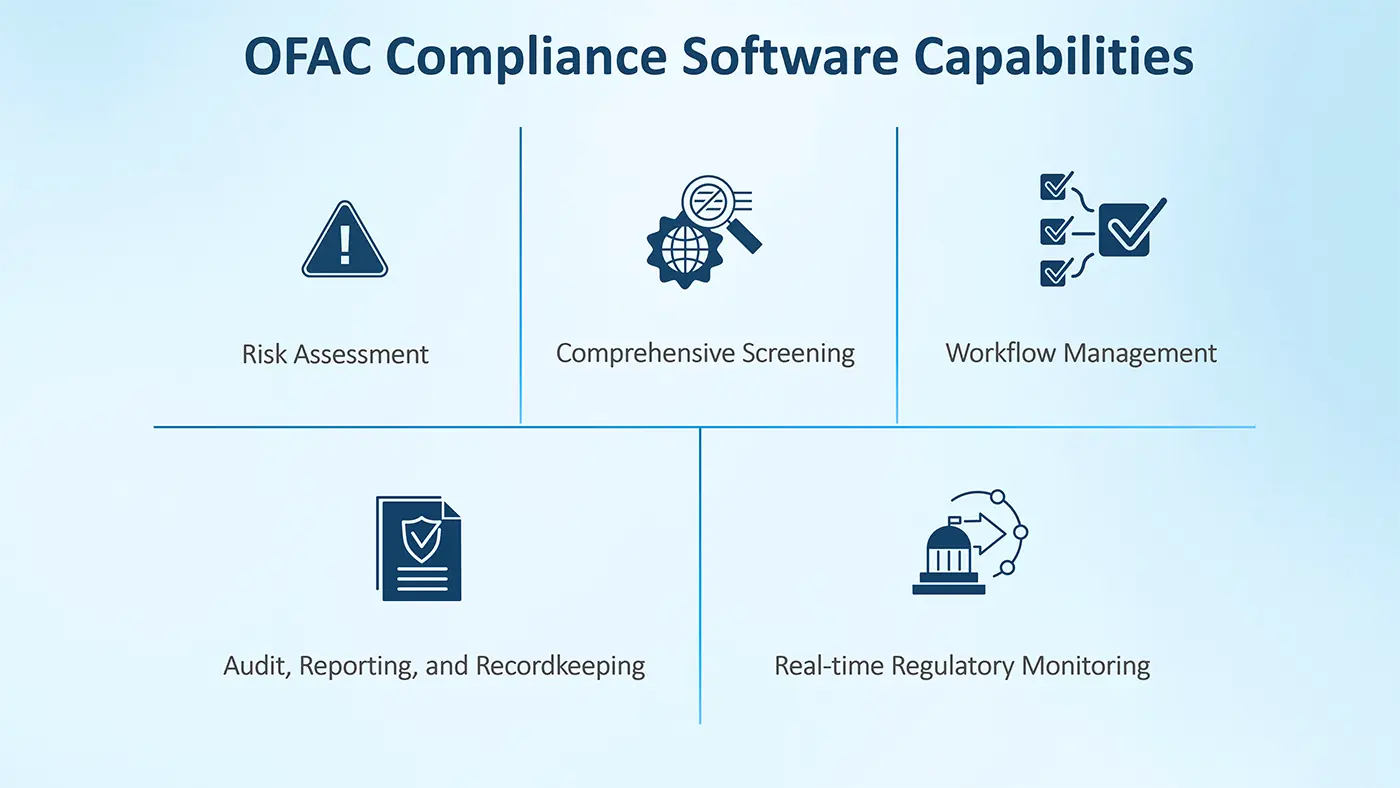
- Integrated OFAC Screening with Centralized Audit Trails: Integrated screening plays a pivotal role in reducing and managing false positives by embedding smarter, context-aware decision-making directly into your operational systems. It centralizes audit trails by logging every action taken on a match, including who reviewed it and what decision was made. This not only supports compliance with OFAC recordkeeping rules but also helps teams analyze patterns in false positives and adjust rules accordingly.
Figure 1: What to look for in best-in-class OFAC compliance software
Best Practices for Improving OFAC Screening Accuracy
Great OFAC sanctions screening tools alone aren’t enough—how your compliance team utilizes them is equally critical. Strategic practices can significantly reduce false positives and enhance overall screening efficiency. Consider implementing the following best practices:
- Regular Data Cleansing and Maintenance: Ensure your data is accurate, current, and standardized to minimize unnecessary alerts.
- Leverage Automation for Routine Alerts: Automate reviews for low-risk, recurring matches using pre-set rules, thresholds, and workflows
- Perform Regular Sanction List Optimization: Ensure screening lists are current and not bloated with redundant, outdated, or irrelevant entries that trigger false hits.
- Monitor System Performance Metrics: Track false positive rates, alert resolution times, and match quality to inform ongoing improvements.
- Segment OFAC Screening Workflows by Risk Profiles: Tailor compliance workflows based on customer or transaction risk levels to avoid over-screening low-risk parties.
- Ongoing Training for Compliance Teams: Equip staff with the latest knowledge of OFAC sanctions programs, watchlist changes, and screening techniques.
Control False Positive Alerts and Strengthen OFAC Compliance with Descartes
Reducing false positives in OFAC screening isn’t just a matter of minimizing noise— it’s a critical step toward improving your entire compliance framework. Every unnecessary alert slows operations, wastes resources, and increases risk.
By choosing sophisticated, AI-powered OFAC screening tools—such as those offered by Descartes—and adopting strategic best practices, you can streamline trade compliance, minimize risk, protect your reputation, and support global growth.
Ready to cut false positives and boost efficiency? Book a demo today and let our experts show you how Descartes can help protect your business and enhance your operations.