
Fleet Performance Management
Delivery Scheduling Software
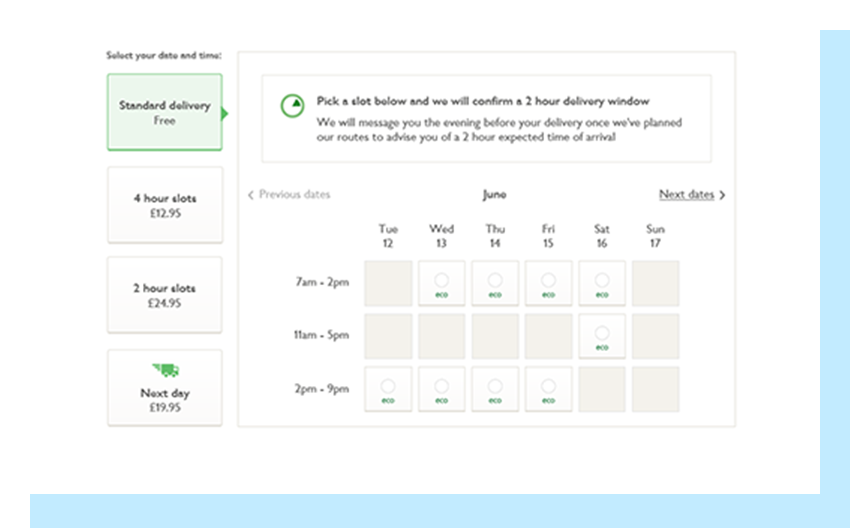
Offer feasible, profitable delivery slots that meet customer expectations and preferences.




Increase Route Profitability
Protect margins and guide customers towards cost-effective options.
- Incentivise fuel-efficient delivery options
- Price slots dynamically based on profitability
- Highlight slots that improve route density
Keep Delivery Promises
Offer dynamic delivery slots powered by continuous optimization.
- Offer slots based on true capacity
- Only show slots that are achievable
- Extend order cutoff times

Continuous Optimization
The route optimization engine works continuously in the background, handling constraints and goals simultaneously to surface cost-effective delivery slots.

Trusted by Leading Retailers and Distributors
“Working with Descartes, we’ve saved 13% on annual fuel costs, which equates to approximately 354,000 fewer miles driven."
Transport and Logistics Director
“The advanced optimization capabilities and architecture of the Descartes solutions were critical, bringing new delivery service options to our customers in an economically feasible way."
Systems Manager
Ready to improve delivery performance?
Connect with our team to get started and see how Descartes can help you streamline routes, reduce costs, and consistently deliver on time and in full.
Featured Resources


Delivery Appointment Scheduling FAQ's
Many retailers set delivery capacity and time slots using historical averages. Customers are presented with pre-defined time windows that don’t reflect real-time constraints such as load size, weight, travel distance, service duration, or driver capabilities.
This method overlooks how much delivery service times vary. Dropping off a few lightweight items is faster than a two-person delivery with installation, or a high-volume drop-off.
Because of this, planners can’t tell if promised time windows are realistic until routes are finalized in batch planning, typically just a day or two before delivery.
This workflow (setting slots, booking deliveries, then planning routes) tends to create one of two outcomes:
- Overly ambitious scheduling: Demand exceeds actual capacity, forcing retailers to reschedule deliveries or outsource them to third-party logistics providers, which cuts into margins and damages customer confidence.
- Overly cautious scheduling: Capacity is underused, leading to inefficient routes and higher cost per stop, along with missed opportunities to fulfil additional orders.
In a batch-planning model, delivery commitments are made with no guarantee of cost-effectiveness or feasibility. This approach arodes profitability and puts on-time delivery at risk.
With smart delivery scheduling, you can control delivery costs while giving customers the choice they expect.
When a customer is booking a delivery, the solution displays slots that are achievable and profitable.
In the background, delivery slots are scored based on time window feasibility and cost-effectiveness, based on factors like capacity, delivery type, estimated service time, customer address, and volume.
Schedules are optimized continuously, so businesses can extend order cutoff times and allow for same- or next-day delivery options.
Yes. Descartes delivery appointment scheduling software is designed for mid-market businesses as well as large enterprises. Organizations with fleets of more than 20 vehicles are an ideal fit when they need to coordinate customer delivery windows with available fleet capacity and optimized routes. Descartes can help growing retailers, distributors and delivery businesses offer achievable appointment options while improving route density, fleet utilization and delivery profitability.
Delivery scheduling based on continuous optimization offers a range of benefits to distributors and retailers:
- Increase profitability: Incentivise customers to select profitable time slots. Offer same-day, next-day and premium delivery options. Serve more customers with the same resources.
- Improved customer satisfaction: Extend order cutoff times and offer slots that suit customers’ schedules. Then deliver on time, as promised.
- Improved delivery density and vehicle utilization: Guide customers towards slots when drivers are already in their area.
- Increased productivity: Book more delivery appointments and serve more customers with the same resources.
- Contribute to environmental objectives: Highlight delivery slots that reduce emissions.
Route planning is about designing delivery routes:
- Assigning stops to routes/drivers
- Sequencing stops
- Calculating the most efficient path from A to B to C
Delivery scheduling decides:
- What time each stop takes place
- How stops line up with customer time windows
The ideal solution will tie these processes together, considering factors like capacity, addresses and service times to align scheduled time windows with optimized routes.
Smart scheduling is ideal for businesses where customers expect to choose a precise time window for delivery. The solution is especially beneficial for businesses with variable service times, where fixed slot reservations are not appropriate:
- Retailers of big, bulky goods
- Two-man and white glove delivery
- B2B wholesale distribution
Dynamic appointment scheduling software lets customers select a delivery slot that works for them at the point of sale (POS).
They might choose a slot based on their preferences for speed, convenience, cost-effectiveness, eco-friendliness. Understanding customer delivery “personas” or preferences—which can also vary by what products are delivered—helps businesses create different delivery experiences for customers to choose from based on their preferences.
The solution displays slots based on true capacity to ensure that you can meet delivery promises without adding vehicles.
Batch scheduling with fixed slot reservations leads to over-optimistic or over-conservative delivery schedules. Either you can’t meet delivery promises, or vehicles are underutilized.
Dynamic scheduling allows you to control costs while offering realistic slots that improve delivery density and on-time delivery.