
Boost Sales Velocity with Integrated Restricted Party Screening
The pressure to grow revenue is intense but so is the scrutiny from regulators. For organizations engaged in global trade, restricted party screening has become a non-negotiable part of doing business. Yet too often, it’s handled reactively rather than proactively. The result? Sales teams are burdened with slow, manual processes and disconnected screening tools—leading to late-stage red flags that jeopardize every deal.
Recent enforcement actions costing millions of dollars in fines, highlight the sobering truth of inefficient screening. Trade compliance violations usually stem from missed warning signs during onboarding or quoting. The Bureau of Industry and Security (BIS) highlights red flags that sales teams encounter often, including:
- Unclear end-use
- Minimal business history
- Preference for cash payments
- Deals pushed through with limited information
When compliance checks are handled too late, companies face real financial and reputational damage That’s why robust sanctions compliance programs add integrated restricted party screening into the same business systems their sales teams use, so risk is caught before a quote turns into a contract.
Video 1: Turning Restricted Party Screening into A Business Enabler

Key Takeaways
- Restricted party screening is often a point of contention for business administrators
- While designed as a safeguard for businesses involved in global trade, when done incorrectly, screening can create roadblocks to sales, waste resources, and lead to burnout
- Integrated restricted party screening enables real-time checks directly within Enterprise Resource Planning (ERP) and Customer Resource Management (CRM) tools, removing bottlenecks.
- Early detection of flagged parties avoids deal delays, rework, and potential violations.
- Automation keeps watchlist data current and screening activity consistent.
- Success requires alignment across all business departments including sales, compliance, and IT from the outset.
Speed vs. Scrutiny: Why Restricted Party Screening Causes Friction
Sales teams thrive on speed—closing deals, onboarding clients, and filling pipeline gaps. But that urgency often exposes businesses to unknown third parties and the compliance obligations that follow.
While enforcement falls to compliance teams, it’s sales that frequently initiate risky engagements. Without integrated denied party screening embedded in sales workflows, these interactions may bypass review entirely.
Image 1: BIS’s Top 5 Risk Indicators at the Quoting & Prospecting Stage
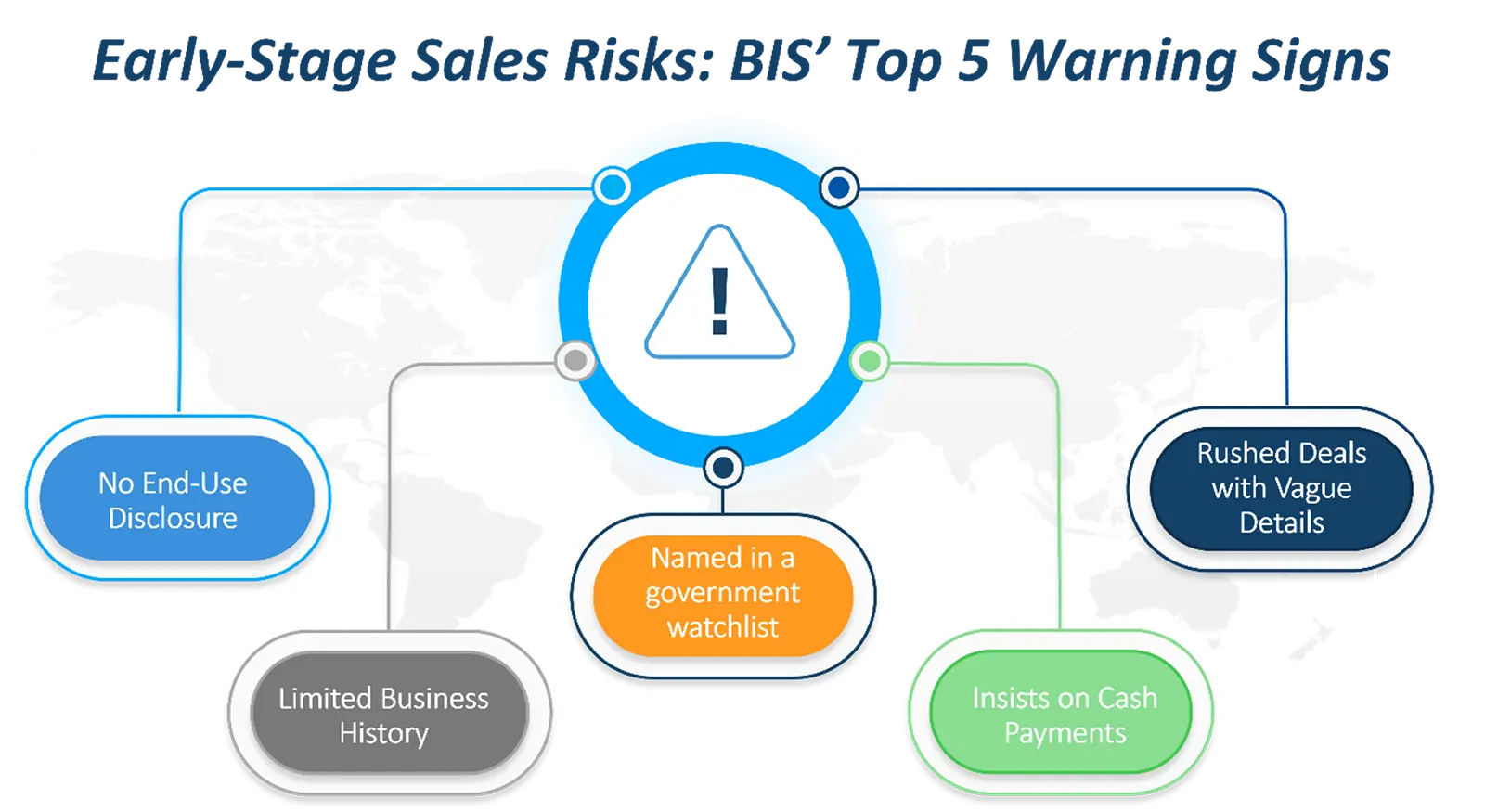
As enforcement from Office of Foreign Assets Control (OFAC), BIS, and the Department of Justice (DOJ) intensifies, companies are being held accountable not just for how they respond to risk—but how they introduce it. Having to go through all of the necessary compliance checks to spot these red flags slows down the work of the sales department, especially with a manual system that introduces unnecessary risk and creates a less efficient sales process with reduced traction.
What are the true costs of manual restricted party screening?
- Loss of Time: Sales reps bounce between systems to run individual checks.
- Lack of Consistency: Reviews are skipped or inconsistently applied across the team.
- Abandoned Deals: Opportunities fall apart when problems are found after transactions.
- Disrupted Momentum: Slow fragmented compliance checks, create longer sales cycles and lower conversion rates.
- Diminished Trust: Manual screening processes are prone to high false positive rates which leads customers to lose patience and trust when they are incorrectly flagged.
Manual reviews also fail to keep up with ever-changing restricted party lists. Without automated synchronized regulatory updates, teams may unknowingly approve a newly sanctioned entity.
Integrating Restricted Party Screening for Revenue Acceleration
The false dilemma between speed and compliance doesn’t need to exist—integrated sanctions screening makes it possible to achieve both. This smarter approach embeds denied party screening directly into the systems sales and operations teams already use, such as CRM platforms, ERP systems, and order management tools. Rather than treating compliance as a separate, manual checkpoint, integrated screening automates risk detection throughout the customer lifecycle—from onboarding and quoting to deal execution and ongoing engagement.
In practice, this means real-time checks are triggered at critical touchpoints: when a lead enters the CRM, when a quote is generated, or when an order is processed. These automated screenings run silently in the background, flagging potential matches against up-to-date global sanctions lists without disrupting workflow. The result is a seamless experience for sales teams and a defensible process for compliance officers.
What sets leading integrated denied party screening software apart is compliance-first, data-driven foundation. AI-powered tools ensure that sanctions data is continuously refreshed, reducing the risk of outdated checks. Every screening action is logged, creating a robust audit trail that satisfies regulatory expectations from agencies like OFAC, BIS, and the DOJ. Instead of slowing down revenue teams, integrated screening empowers them to move faster—with confidence that every transaction is vetted, documented, and aligned with global trade laws. This creates not just smarter trade / export compliance programs but also smarter business processes.
As Descartes’ Director of Industry Strategy, Jackson Wood puts it, “CRM platforms aren’t just for managing relationships—they’re powerful engines for compliance when paired with the right screening tools. That integration is what turns risk management into a seamless part of the sales process.”
Competitive Advantages that Go Beyond Trade Compliance
Integrated restricted party screening isn’t simply a compliance upgrade, it is a strategic advantage that delivers measurable business impact by boosting commercial agility and reducing regulatory risk. Here are some major benefits that integrated screening offers:
- Accelerated Deal Velocity: Automated checks flag restricted parties early, preventing wasted time on deals that would later be disqualified.
- Reduced Risk Exposure: Up-to-date sanctions data and defensible audit trails help avoid costly fines and regulatory penalties.
- Improved Team Alignment: Sales and compliance teams stay in sync, reducing friction and building trust across departments.
- Higher Compliance Rates: Digital tools ensure no entity is left unchecked, even as global sanctions lists evolve.
- Optimized Technology Investments: Screening within platforms like Salesforce maximizes Return on Investment (ROI) and streamlines workflows.
Case in point: Movella and Argosy reduced time spent on compliance by 75% after automating its screening process—boosting productivity, accuracy, and decision making while lowering exposure to trade-related risks
5 Tips to Get Started with Integrated Restricted Party Screening
Integrating restricted or denied party screening software begins with evaluating how compliance workflows intersect with daily operations. The goal is to streamline—not reinvent—how screening is performed across systems and teams. Follow these steps for a smooth rollout:
- Set clear goals: Identify where you want to accelerate decision making, eliminate siloed systems, or reduce manual overhead.
- Map the sales cycle: Know where in the sales process new parties enter and ensure alerts are configured at key acquisition and fulfilment stages.
- Get everyone involved: Sales, IT, and compliance must coordinate on requirements.
- Select the right vendor: Choose a provider with deep CRM/ERP integration experience and the ability to automate sanctions list updates.
- Provide support: Offer training, documentation, and help resources to drive usage.
Explore more best practices in detail with our earlier blog: Top Five Best Practices to Integrated Denied Party Screening
Build a Safer, Faster Sales Engine with Descartes Trade Compliance Software
Manual reviews are too slow for modern sales. By adding integrated restricted / denied party screening directly into operational systems, businesses can move quickly, avoid violations, and ensure every deal starts on solid ground.
Trade compliance requires the right balance of staying within the confines of the law while scaling securely. Descartes denied party screening solution integrates with a wide range of business platforms including Salesforce, Microsoft Dynamics, NetSuite, Oracle, SAP, and many more including homegrown systems. The combination of our award-winning compliance technology with these applications makes real-time global screening protection, audit readiness, and seamless compliance possible.
Ready to learn more? Request a demo and see how Descartes can help you drive growth without sacrificing compliance.
Find out what our customers are saying about Descartes Restricted Party Screening on G2 – an online third-party business software review platform. Additionally, you can read this essential buyer’s guide to denied party screening to help you select a solution that fits your needs.