Visibility isn’t a nice-to-have anymore, it should be the nerve center of your transportation network. Supply chain teams require more than static transport schedules and occasional updates to effectively monitor shipments, especially in a world where daily operations are subject to delays and capacity changes.
The key difference between a standalone Transportation Management System (TMS) and a TMS with embedded real-time visibility capability is the difference between reacting late or being able to respond proactively.
In this article, we explore why a real-time transportation visibility platform (RTTVP) integrated in your TMS is so important for tracking your shipments and why a standalone TMS falls short in today’s supply chain.
The Hidden Problem with a “Good Enough” TMS
For years, TM systems have relied on ad hoc status updates and manual follow-ups to monitor operations on the road, rails, or at the port. They can build loads, rate shipments, assign carriers, and centralize documentation, which was “good enough” in the past. Today, these systems are no longer acceptable since they lack live tracking data, trigger manual processes, and have limited exception handling. These issues become more pronounced as networks grow, become more complex, and service expectations increase.
Your TMS may be consolidating and rating perfectly, but if you can’t see your shipments in real time, you’re managing blind. Customers' expectations, carrier networks, and supply chain complexity have all evolved beyond what a “good enough” TMS can handle. These limitations explain why businesses are abandoning such outdated TMS solutions and moving towards a TMS which has a truly embedded real-time visibility module.
Why Visibility Defines Modern Transportation Management
The modern supply chain is in constant motion due to competitive pressure, more moving parts, and more operational risks. Static systems and batch updates cannot keep up. Teams need a TMS that sees what’s happening now, anticipates what comes next, and automates actions that protect service and cost. That is the promise of real-time visibility paired with a TMS.
Anything less introduces blind spots, delays, and avoidable spending. A supply chain visibility tool integrated with your transportation management system delivers automated actions when needed and gives you actionable insight before disruptions become costly.
Visibility has shifted from being an advantage to a necessity. Without real-time updates from your TMS, you can't prepare for upcoming events. As the number of carriers and customer expectations grow, managing connections and data becomes paramount. Visibility now represents a shift from merely reacting to proactively anticipating needs. With the rise of artificial intelligence (AI), the increased amount of data that real-time visibility offers also creates opportunities for more AI-initiated automated actions based on complex data.
The future of Transportation Management is connected, visible and built to last
Experience how Descartes unites TMS and real-time visibility to simplify operations and scale your business
The Risks of a Standalone TMS
Standalone disconnected TMS solutions can plan and prepare shipments, but they can’t see them and what you can’t see, you can’t manage.
The cost and risks of staying disconnected is much higher than most supply chain executives realize:
- Lacking tracking data slows down decision-making. You’re left waiting for updates instead of leading with real-time insights.
- Data blind spots create constant issues and frustrations. Delays and disruptions aren’t detected until it’s too late.
- Without insights, customers or any stakeholder involved start asking questions. So, every missing link means more manual work and higher risks. decisions supported by audit-ready records and authoritative data sources
- Disconnected/offline TMS platforms can’t keep up. Transportation management systems that initially meet a company’s needs can quickly become outdated as supply chains and technologies advance.
Many companies switch systems to adapt to their business needs, believing the next one will solve the problem. But without built-in connectivity and visibility, each system eventually becomes another outdated tool. A standalone TMS might save some money today, but it keeps a lot of unnecessary manual work intact, decreases your supply chain resilience, and leaves you without full control.
What Real-Time Visibility Adds
The value of real-time visibility is clear: lower costs, a more reliable supply chain, and happier customers.
A RTTVP amplifies your TMS by removing manual work and uncertainty. With end-to-end supply chain visibility, teams always know what’s happening and what needs attention.
Here’s what it delivers in practice:
Continuous, automated tracking across all modes reduces manual status checks, internal follow-ups, and customer calls.
Predictive ETAs and precise location give a true picture of transportation status, leading to fewer surprises and better on-time performance.
Early notifications help teams and customers act before delays escalate, reducing reactive work and firefighting.
A single source of truth replaces disconnected systems, making it easier to collaborate, communicate and respond quickly.
Built-in connectivity improves data quality and consistency across regions, carriers, and modes.
As a supply chain visibility solution, an RTTVP doesn’t add complexity. It works as a supply chain visibility tool that simplifies operations, strengthens reliability, and makes it easier to deliver on customer expectations.
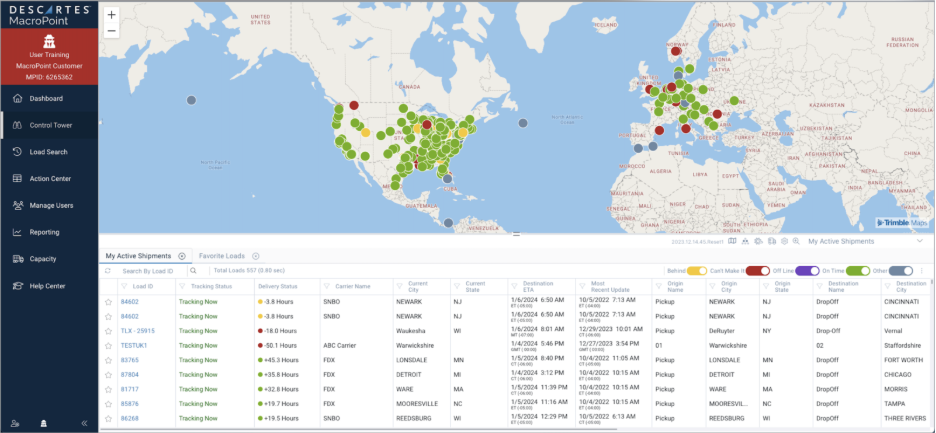
Control tower data view from Descartes MacroPoint
The One-Stop Connected Platform
Why settle for another system when you can have a lasting logistics ecosystem? Most supply chain teams aren’t looking for just a TMS, they are looking for the last one they’ll ever need, a single, scalable platform that connects planning, execution, and visibility in a seamless flow. That is exactly what Descartes delivers, a one-stop connected platform.
The Descartes Transportation Management solution has embedded the most advanced real-time visibility capability, which will bring your business:
- All information from one source for every shipment, from planning to delivery.
- One network linking shippers, carriers, brokers, and logistics partners in real time.
- One platform that evolves with your business, eliminating the costly cycle of switching systems every few years.
Most logistics teams don’t want another piece of software to handle, they want a single platform that brings their transportation, visibility, and network together. Every time a company changes TMS providers, it pays a steep hidden price: retraining teams, re-onboarding carriers, rebuilding integrations, and losing valuable historical data.
The cycle happens because most systems are built for yesterday’s problems, not for tomorrow’s growth. When your network and operations evolve, your TMS should evolve with it, not hold you back.
If a TMS with embedded real-time visibility is not an option for you, your TMS can also be enhanced with an external real-time visibility capability. With the Descartes MacroPoint™ solution, real-time visibility isn’t an add-on, it’s designed to seamlessly integrate with your TMS. Shipments are automatically tracked across all modes and carriers, powered by one of the industry’s most extensive and reliable global visibility networks. Whether you manage a few carriers or thousands, data flows seamlessly into our TMS, providing instant status updates, predictive ETAs, and actionable alerts.