
Industry-Specific Export Licensing Rules Explained for Global Compliance
Trade compliance professionals know the stakes: a missing export authorization form can halt shipments, trigger regulatory audits, or land your company in headlines for all the wrong reasons. Real protection, however, begins with mastering export licensing rules at a granular, industry-specific level.
Why? Because “controlled” doesn’t just mean missiles or malware. Dual-use hardware, source code, cloud-based tech—even corporate communication—can cross export control thresholds if the receiver or destination raises red flags. Global frameworks set the stage, but each country fine-tunes its rules to reflect national security priorities—so the same router, valve, or research paper may carry vastly different regulatory obligations depending on where it’s going.
Smart teams don’t rely on generic compliance checklists. They build risk-tiered playbooks aligned with their industry’s actual threat vectors:
- Strategic value of the item (spacecraft parts vs. notebooks)
- Destination sensitivity (trusted allies vs. embargoed states)
- End-user profile (defense contractor vs. fashion retailer)
- Oversight agency—Bureau of Industry and Security (BIS), Directorate of Defense Trade Controls (DDTC), and others with unique licensing nuances.
With rising penalty ceilings—and personal liability for executives—the message is clear: precise export classification and rigorous screening aren’t just best practices; they’re survival strategies. Manual export licensing approaches are insufficient to meet the complex export control regime present in most industries.
Key Takeaways
- Export license requirements vary significantly across industries due to differing risk profiles and regulatory priorities.
- Understanding industry-specific export controls helps prevent costly penalties and compliance pitfalls.
- Dual-use and controlled items shape export licensing demands uniquely within each sector.
- Strategic, informed risk assessments rooted in industry realities improve export compliance effectiveness.
Industry-by-Industry Breakdown of Export Licensing Requirements
Before diving into sector-specific rules, keep this in mind: every export licensing decision hinges on three critical variables—product type, destination risk, and end-user intent. Shift just one of these, and yesterday’s “no-license-required” shipment can become tomorrow’s headline export violation. The snapshots below reveal where the pressure points lie across industries—and why a cookie-cutter checklist won’t cut it in today’s export landscape.
Export Authorization Rules for Aerospace & Defense Industry
Products in the aerospace and defense industry are often dual use, serving both military and civilian markets, which subjects them to strict oversight. Overview of the export licensing landscape:
- Major Regulators – Defense items on the United States Munitions List (USML). fall under International Traffic in Arms Regulations (ITAR) via the DDTC, while dual-use aerospace goods are governed by the Export Administration Regulations (EAR) through BIS. In Europe, oversight comes from the EU Common Military List and Dual-Use Regulation.
- Typical Export Licenses – Technical Assistance Agreements (TAAs) and Manufacturing License Agreements (MLAs) for foreign repair or co-production, EAR licenses for spares (Export Control Classification Number (ECCN) 9A991) bound for embargoed states.
- Frequent Complexities – Minor design modifications can trigger reclassification, complicating export compliance. Additionally, the ongoing Export Control Reform continues to create regulatory friction.
Export Authorization Rules for Biotechnology & Pharmaceuticals Industry
The biotech sector faces intensive export controls due to biosecurity risks and dual-use potential in research tools and materials. Developments like gene-assembler software promise miracles of medicine but they also risk unleashing a biosecurity Pandora’s box.
- Major Regulators – In the U.S., BIS governs exports of biotechnology and pharmaceutical items such as pathogens, toxins, fermenters, specialized bioreactors, containment systems, and technical documentation. Globally, the Australia Group shapes regulations in the EU, Canada, and beyond.
- Typical Export Licenses – Special Comprehensive Licenses (SCL) may be required depending on the product classification and scale of exports.
- Frequent Complexities – Rapid regulatory changes driven by national security threats, the difficulty of distinguishing commercial biotech from weaponizable materials, and “deemed export” risks are some of the challenges specific to this sector.
Export Authorization Rules for Semiconductors Industry
Semiconductors sit at the center of national security, artificial intelligence (AI), and critical supply chains, driving stringent, rapidly changing controls. Scrutiny is likely to intensify as the upcoming BIS 50% rule broadens risk to ownership-linked counterparties. Here’s what export licensing for semiconductors looks like:
- Major Regulators –Dual-use semiconductors and related equipment are controlled by BIS under EAR in the U.S. The EU Dual-Use Regulation and the UK Export Control Joint Unit (ECJU) govern comparable controls.
- Typical Export Licenses – The need for Temporary General Licenses (TGLs) may be triggered when exporting semiconductor components with high performance density under certain circumstances. This includes items classified under BIS EAR Category 3 ECCNs like 3A090 (semiconductors), 3A001 (integrated circuits), and 4A090 (advanced computing and related technologies).
- Frequent Complexities – Fast-moving rule updates impact compliance; complex performance criteria and technology notes; multi-country manufacturing flows requiring jurisdiction mapping; rigorous screening for foundries, design houses, research institutes, and cloud/AI providers; higher exposure to deemed export violations demands careful handling of technical data and remote access.
Export Authorization Rules for Telecommunications & Information Security Industry
Technologies within the telecommunication industry enable connectivity across borders, but their strategic importance also makes them potential vectors for national security risks. From encryption standards to supply chain integrity, export controls surrounding telecoms are designed to safeguard critical infrastructure while balancing the demands of international trade.
- Major Regulators –BIS administers most telecoms-related exports through the EAR. DDTC may also regulate cryptographic or defense-grade technologies under ITAR. Internationally, regulators such as the European Commission’s DG TRADE plays pivotal roles in enforcing export controls and dual-use regulations.
- Typical Export Licenses – US exporters often require a BIS license for items classified under ECCNs related to encryption (e.g., 5A002, 5D002). For defense-related Information and Communications Technology and Services (ICTS), an ITAR license is mandatory. License exceptions like Encryption Commodities (ENC) may apply depending on destination and end-use.
- requent Complexities – Navigating encryption classification, deemed exports, and foreign national access are frequent challenges. Rapid tech evolution, shifting country controls, and dual-use concerns demand constant vigilance and practical export compliance strategies to avoid violations or costly delays.
Export Authorization Rules for Chemical Industry
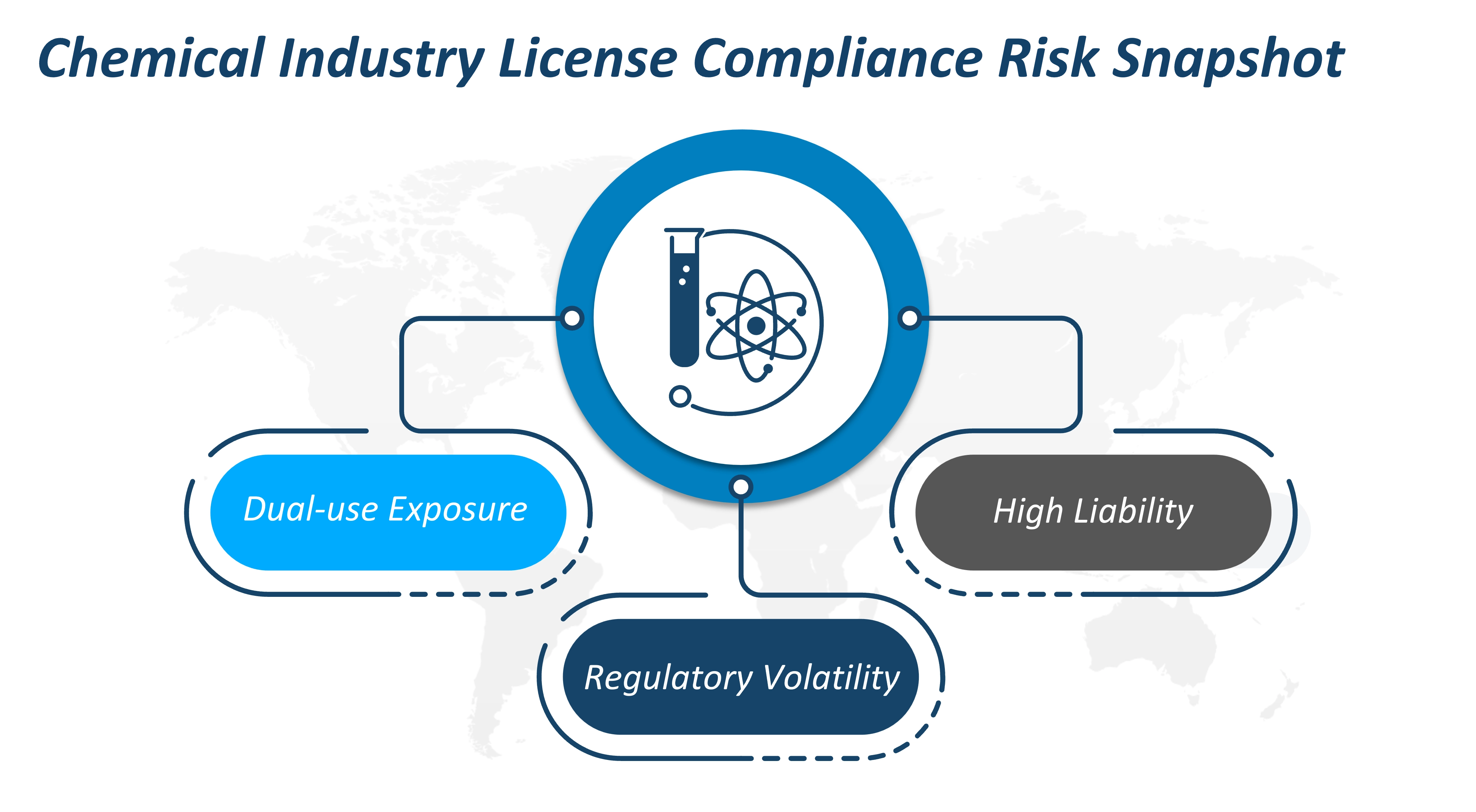
Chemical and materials exports are tightly managed due to proliferation risks and dual-use applications across defense and energy.
- Major Regulators – BIS regulates exports in the U.S.; compliance also intersects with the Chemical Weapons Convention (CWC). The EU Dual-Use Regulation governs dual-use substances and equipment; the ECJU oversees national compliance in the UK. Additional health/safety regimes (e.g., Registration, Evaluation, Authorization, and restriction of Chemical substances (REACH) may apply separately.
- Typical Export Licenses –License Exception Strategic Trade Authorization (STA) sometimes applies but is narrowly scoped and subject to specific conditions. Generally, export licenses for chemicals depend on the classification, intended end-use, end-user profile, and export destination. Threshold quantities apply.
- Frequent Complexities – Identifying when innocuous precursors become controlled by concentration, purity, or end-use; complex catch-all provisions tied to weapons proliferation; multi-industry customer bases requiring thorough end-user and end-use due diligence; documentation for blending, re-export, and technology transfer across global sites.
Export Authorization Rules for Nonprofit Sector
The nonprofit sector plays a vital role in global development, humanitarian aid, and public health—but it’s not exempt from export controls. Non-Governmental Organizations (NGOs) must navigate export licensing requirements when handling controlled items like dual-use technologies, medical equipment, communication devices or data across borders.
- Major Regulators – U.S. nonprofits face oversight from BIS for dual-use items, DDTC for defense-related exports, and DOE for nuclear-related technologies. Internationally, agencies like UK’s ECJU and Japan’s Ministry of Economy, Trade and Industry (METI) also enforce export rules.
- Typical Export Licenses –NGOs may require export licenses for goods with ECCNs like 2B352 (biological equipment), 1C990 (fertilizers), and deemed export licensing, depending on destination and end-use.
- Frequent Complexities – Challenges include determining ECCNs, managing deemed exports involving foreign nationals, and navigating license exceptions. Humanitarian missions in sanctioned regions often require case-by-case licensing, making proactive export compliance planning essential to avoid delays or violations.
Export Authorization Rules for Energy (Nuclear & Oil/Gas) Industry
The energy sector—especially nuclear and oil/gas—plays a critical role in global security and economic stability. Due to its environmental and geopolitical impact, it faces comprehensive regulations to prevent proliferation and uphold safety standards.
- Major Regulators – The Department of Energy (DOE), Department of State (DOS) and BIS are the key regulators oversee licensing and controls for exports from the U.S. involving nuclear materials and technologies. Global rules are shaped by the Nuclear Suppliers Group and Wassenaar Arrangement.
- Typical Export Licenses –Determine if the item falls under DOE Part 810 authorization which controls the transfer of unclassified nuclear “technology” or any of the BIS export classification (ECCN 0C001, 2A290, 2B999) for nuclear materials and generic oil-field gear. Depending on the determination, your energy export may require a specific or general license.
- Frequent Complexities – Multifaceted and overlapping regulatory agency sign-offs, sudden sanction expansions that rope in routine drilling equipment, and recordkeeping gaps on fuel-cycle consulting services.
Export License Compliance Best Practices with Broad Cross-Sector Impact
- Start with Your National Export Control Rulebook
Global regimes set the baseline, but national control lists—like the U.S. Commerce Control List (CCL), EU Dual-Use List, and Canada’s Export Control List (ECL)—define the actual restrictions. Always begin with the country-specific export control rules. - Apply the Four W’s of Export Licensing
What’s the item? Where’s it going? Who will use it? Why will they use it? These four questions determine your export licensing needs. Accurate answers ensure compliance with international export control laws. - Classify with Precision
Misclassifying an item under the wrong ECCN or USML category can lead to major export violations for businesses subject to U.S. laws. Reevaluate classifications whenever product specs or export regulations change—precision is critical for legal compliance. - Conduct Rigorous Denied Party Screening
Run customers, intermediaries, and even resellers against sanctions, restricted, and denied party lists. Investigate any red flags before exporting goods or sharing data. - Guard Controlled Technology Transfers
A Zoom session with source-code or technical data sharing can be a “deemed export.” Treat virtual exchanges with the same rigor as physical shipments. - Keep an Export Compliance Audit Trail
Export classification and license determination decisions, export licenses, exception rationales, end-use statements, restricted party screening logs—record everything. Auditors appreciate documentation; enforcement agents demand them. - Implement an Export Compliance Program
Establish a robust Export Compliance Program with training, automated export classification tools, export licensing software, and a clear Voluntary Self-Disclosure (VSD) process. A timely VSD can turn a misstep into a manageable fix. - Bring in Export Control Experts
Collaborate with qualified export control professionals or legal advisors to interpret complex regulations, validate classifications, and guide licensing decisions. Expert involvement strengthens compliance and reduces regulatory risk.
Descartes: Your Trusted Partner for Export License Compliance Worldwide
Export controls aren’t obstacles—they’re safeguards for technology, capital, and credibility. Strategic export licensing accelerates shipments, mitigates risk, and builds trust in sensitive markets.
For a complete solution, look to Descartes OCR Global EASE™—an end-to-end platform designed to manage every aspect of export compliance. Integrated seamlessly into your IT environment, this all-in-one solution simplifies deployment and scales with your needs. Descartes streamlines export license compliance with:
- Automated export license management including applications & tracking – Reduce manual data entry and errors.
- Precise export license determination – Pinpoint the exact license you need in minutes, slashing research time.
- Direct government portal integration– Seamlessly connect with major global regulatory bodies including the U.S., UK, and the EU.
- Modular capabilities– Scale as needed with modules for Export Operations, Authorization Management, Restricted Party Screening, Incident Management, and more.
- Centralized export compliance management – Gain full visibility and control over export authorizations.
Don’t let inefficiencies drain your resources any longer. Book a demo today and start optimizing your export licensing process.