
A critical regulatory shift is on the horizon. The U.S. Department of Commerce’s Bureau of Industry and Security (BIS) is advancing the BIS 50% rule, a proposal that could significantly change how companies assess sanctioned ownership risk in global transactions. The proposed rule would treat any business that is at least half-owned, either directly or indirectly, by parties on the BIS Entity List as if it were listed itself.
This pending regulation could instantly increase the scale of due diligence obligations for thousands of companies. Many entities that previously flew under the radar may soon trigger export control restrictions, even if they’re not explicitly named. The move is intended to close a well-known enforcement gap that allows restricted parties to operate through lesser-known affiliates, shell companies, or investment vehicles.
Though the rule is not yet final, the direction is clear. Businesses should prepare now to avoid future export violations, operational disruptions, and regulatory penalties.
Key Takeaways
- The BIS 50% Rule will restrict entities majority-owned by listed parties—even if unnamed.
- It closes a loophole by targeting indirect ownership and subsidiaries.
- Denied party screening must expand to cover aggregated control and hidden links.
- Delayed preparation raises the risk of violations, fines, and shipment disruptions.
- Companies should update tools, policies, and training now to meet evolving compliance demands.
Understanding the BIS 50% Rule
The BIS 50% rule proposes a major expansion in how the U.S. enforces its export control regulations. If adopted, the rule would place restrictions on any entity that is owned 50% or more, directly or indirectly, by one or more parties on the BIS Entity List, even if the entity itself is not explicitly named on a watchlist.
Today, restrictions apply only to those entities specifically listed. This limitation has allowed many restricted parties to sidestep controls by conducting business through affiliates, shell companies, or layered ownership networks. The BIS has described this as a regulatory “whack-a-mole” problem, where enforcement can’t keep up with evolving ownership structures.
To address this, the BIS 50% rule mirrors the structure of a similar rule by the Office of Foreign Assets Control(OFAC), the OFAC 50% rule, but is tailored for trade compliance rather than sanctions enforcement.
Changes Introduced by the BIS 50% Rule
The main components of the rule aim to:
- Restrict unnamed entities not just direct parent-subsidiary relationships, but to complex or multi-tiered ownership chains where 50% or more are owned, directly or indirectly, by one or more parties the BIS entity list.
- Aggregate ownership stakes such that control is calculated cumulatively. For example, two listed entities each holding a 25% stake may trigger the 50% threshold.
- Automatically apply to complex ownership structures including subsidiaries, holding companies, shadow networks and any entity meeting the rule’s ownership criteria without needing to appear individually on the denied party list.
Table 1: Side-by-Side Analysis: OFAC and BIS Ownership Restrictions
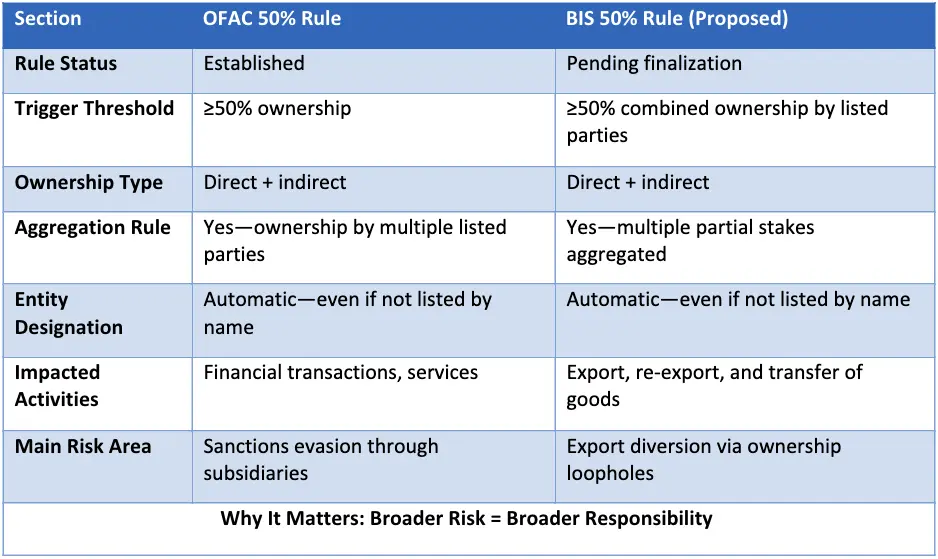
This proposed rule reflects growing concern around national security and export control enforcements. The primary motivating factors include:
- Preventing tech diversion to adversarial military programs, particularly in China, Russia, and Iran.
- Strengthening enforcement by eliminating the need for time-consuming case-by-case designations.
- Responding to bipartisan pressure: A 2023 report by the House Foreign Affairs Committee criticized the BIS Entity List as ineffective without ownership-based controls.
What the BIS 50% Rule Could Mean for Your Compliance Program
The proposed BIS 50% Rule brings a structural overhaul of export compliance. If finalized, it will require companies to rethink how they identify restricted entities, shifting from name-based screening to ownership-based enforcement. This change represents far more than a longer watchlist. It expands the enforcement scope and increases global trade complexities that businesses need to carefully prepare for.
- More complex denied party screening: The rule requires organizations to screen for ownership, not just names. That means tracing corporate structures through parent companies, joint ventures, and indirect investors. Many screening tools in use today aren’t equipped to uncover these layered connections, raising the risk of missing restricted parties and triggering higher false positive rates due to complex ownership overlaps.
- Higher risk of violations without ownership visibility: Companies who lack capabilities to map corporate ownership risk unintentional export control violations. Opaque structures make indirect control hard to detect, especially across borders or with rapidly shifting ownership.
- Supply chain volatility within sensitive technology sectors: Organizations managing dual-use goods, telecom infrastructure, or advanced chips will be most affected. A single unresolved ownership link in a supply chain can lead to shipment delays, licensing pauses, or urgent sourcing shifts especially under stricter export control regimes like the BIS 50% Rule.
- Broader due diligence needs: Export compliance teams will need to expand their reviews, mapping ownership structures, monitoring changes in control chains, and documenting findings. What used to be a scheduled task now calls for active, ongoing monitoring to meet audit expectations.
- Greater geopolitical and operational risk: Countries affected by the rule, particularly China, may respond with retaliatory measures. That raises the stakes for multinational supply chains, which are already under strain from shifting trade rules.
With enforcement likely to ramp up quickly once the rule is finalized, businesses can’t afford to treat these risks as hypothetical. Understanding the scope now will make it easier to act decisively and avoid compliance gaps later.
How to Get Ready for the BIS 50% Rule: A 5-Step Compliance Checklist
Finalization of the BIS 50% rule is only a matter of time. Compliance leaders should begin preparing their systems, policies, and teams now to ensure readiness before the rule becomes enforceable. Here’s a focused checklist to strengthen your export compliance posture:
- Evaluate your restricted party screening software: Many solutions only catch direct name matches. Under BIS 50% rule, you’ll need tools that uncover indirect and aggregated ownership—tracing relationships across corporate layers. Systems should be able to map nested ownership paths and identify entities that don’t appear on any denied party list but still fall within scope.
- Expand your due diligence framework: Go beyond surface-level checks. Map corporate structures for customers, suppliers, and partners—including subsidiaries, shareholders, and indirect owners tied to the BIS Entity List. This is especially critical in high-risk regions and sectors flagged for tech diversion concerns.
- Embed screening into business systems: Integrate denied party screening into your ERP, CRM, and procurement platforms so it runs automatically at critical points—customer onboarding, order booking, payment, and fulfillment. For guidance, follow these best practices for integrated restricted party screening.
- Refresh internal policies and training: Ensure your export compliance policies accurately reflect the new sanctioned ownership thresholds. Train all relevant departments, including compliance, procurement, sales, logistics, and legal on how to identify ownership red flags and what to do when they appear. Documentation and escalation procedures should be clear and consistent.
- Work with a specialized compliance vendor: Ownership networks evolve constantly. Spreadsheet-driven tracking won’t scale. Partnering with a technology provider gives you access to timely list updates, AI-powered screening accuracy, and ongoing monitoring tied to BIS 50% rule updates.
Achieve BIS 50% Rule Readiness with Descartes Export Compliance Solutions
With the BIS 50% rule looming, proactive compliance isn’t optional. Descartes offers purpose-built export compliance solutions to handle ownership complexity at scale, with:
- Sanctioned party ownership screening: Uncover indirect and aggregated ownership using enhanced data sources. Our specialized screening data provides deeper visibility into complex ownership chains so you can easily comply with the BIS 50% rule.
- Real-time list updates: Access a global, frequently updated database of denied and sanctioned lists to track evolving regulatory designations.
- Automated workflows: Streamline review, escalation, and documentation with built-in compliance manger workflows.
- AI assisted denied party screening: Enhance accuracy and accelerate screening with AI-driven precision that reduces false positives by 40 to 60%.
Find out more about our denied party screening software and contact us to speak to an expert about how we can help your team comply with the BIS 50% rule.