Why Freight Visibility Matters
A guide to understanding the competitive advantages provided by real-time visibility
Real-time freight visibility turns transportation data into better decisions. One delayed shipment can trigger a ripple effect across production, inventory, labor planning, and customer service. Real-time freight visibility allows organizations to move from reacting to disruptions to proactively managing them.
Know what is happening to your shipments, catch potential delays sooner, and act where it matters most.
Key Takeaways
• One delayed shipment can spread across the business. It can affect production schedules, labor planning, inventory, customer service and revenue.
• Real-time freight visibility goes further than track-and-trace. Track-and-trace shows where a shipment was. Real-time visibility shows where it is now, when it will arrive, and which loads need attention.
• The biggest benefit is managing by exception. Teams stop checking every load by hand and focus on the shipments at risk of delay.
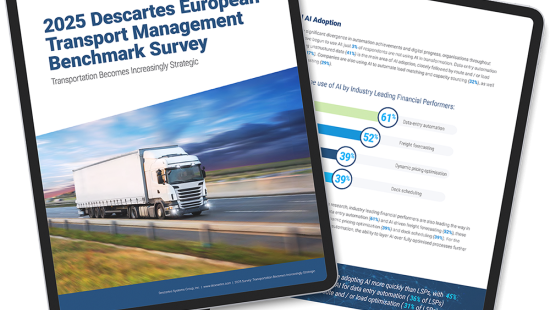
• There’s still a large automation gap. In Descartes’ 2025 Transportation Management Benchmark Survey, 81% of shippers and logistics service providers called transportation management a differentiator or competitive weapon, yet only 17% are fully automated.
• Choose a solution based on five factors: network scale, broad carrier connectivity, reliable cloud infrastructure, integration with your TMS, ERP and WMS, and ongoing investment in AI and automation.
Why Visibility Has Become a Business Need
Transportation teams today cannot operate based on simply knowing where a shipment was last scanned. They need timely updates that show where their freight is now, what is changing, and where risks are starting to build.
Visibility is now business-critical for teams that have to control costs, protect service levels, and respond faster when things go off track. It allows them to manage by exception and that is where its primary benefit lies. Instead of checking shipments manually, teams can focus on the ones that are late, off schedule, or likely to disrupt the daily operations.
With limited freight visibility, one delay can impact the business at different levels, including:
PRODUCTION RISK
Inbound delays that interrupt manufacturing schedules
LABOR RISK
Inefficient warehouse, dock and yard planning
INVENTORY RISK
Shortages, stock-outs, and late replenishment
CUSTOMER EXPERIENCE RISK
More service inquiries and less proactive communication
PERFORMANCE
RISK
Limited oversight of carrier and partner execution
REVENUE
RISK
Lost business opportunities caused by poor service levels
The Cost of Limited Freight Visibility
The fact that, every day, transportation disruptions occur makes it essential to identify the relevant shipments in time to prevent any kind of costs, service or customer failures.
Without real-time transportation visibility, teams are more exposed to missed deliveries, carrier detention, manual follow-ups, and last-minute problem-solving. Each of these adds cost and pressure across the transportation operation.
Descartes’ 2025 Transportation Management Benchmark Survey shows why this matters: 81% of shippers and logistics service providers see transportation management as a differentiator or competitive weapon, yet only 17% are fully automated. When teams are still relying on manual processes, visibility gaps can quickly become a business risk.
The ROI Behind Freight Visibility
To improve financial and service KPIs, companies must have a way to view, analyze, and communicate multimodal and visibility data in real-time.
Move Beyond Track-and-Trace
With track-and-trace you know where a shipment was. Real-time freight visibility tells you where it is now, what is the next step, and which shipments require attention.
Piecing together updates from different sources, as in traditional tracking methods, makes it harder for teams to respond effectively. They expect a clearer view across shipments, carriers, modes and borders, so that they can act faster.
Modern freight visibility solutions should help teams:
- Track shipments in real time with accurate, timely status updates
- Improve ETA accuracy and stay informed throughout the shipment journey
- Monitor arrivals, departures, and in-transit events across transportation modes
- Use a control tower view to improve visibility across purchase order, shipment, and proof-of-delivery processes
- Connect more efficiently with carriers and trading partners through a broad logistics network
- Automate repetitive tracking and exception workflows so teams can focus on the loads that need attention
The result is that teams spend less time chasing updates and more time acting on the shipments that matter most.
Manage Freight by Exception, Not by Spreadsheet
Instead of asking, “Where is everything?”, transportation teams can focus on what really matters: “Which shipments need attention right now?”
Real-time visibility automation and AI-driven exception workflows help teams stop manually checking every shipment and start focusing on the exceptions that could affect service, cost, or customer experience.
Why Leading Shippers Are Making Real-Time Visibility a Priority
Knowing where shipments are and when they’ll arrive helps teams make better decisions and respond more quickly when plans change. That’s why leading shippers invest in real-time visibility.
- Keep deliveries on track with reliable ETAs and in-transit updates
- Reduce manual check calls and repetitive shipment follow-ups
- Identify delays, disruptions, and exceptions earlier so teams can act faster
- Strengthen carrier collaboration through reusable connections and standardized messaging
- Improve customer service with proactive status updates and fewer “where is my shipment?” inquiries
- Use transportation data and analytics to make faster, more confident decisions
- Gain greater control across shipments, carriers, modes, borders, and delivery processes
What to Look for in a Freight Visibility Solution
Not every visibility provider can give teams the same level of network coverage, carrier connectivity, or practical insight.
Focus on five capabilities that determine whether the provider’s solution can deliver real-time visibility in practice:
Proven Scale
A platform supported by a large logistics network, with the reach to connect shippers, carriers, logistics service providers, and other trading partners across complex supply chains.
Broad Connectivity
Flexible carrier connectivity across APIs, EDI, web portals, mobile apps, ELDs, TMS connections, and other data sources, so teams can improve tracking coverage.
Reliable Infrastructure
Cloud-native technology designed to support availability, scalability, security, and business continuity across transportation operations.
System Integration
Bringing data into the systems your teams already use, from TMS and ERP to WMS and carrier tools, making information accessible and actionable.
Nonstop Innovation
A provider investing in advanced automation, AI-driven exception management, predictive insights, and reliable real-time data, which helps teams reduce manual work and make better decisions.
Why Descartes Real-Time Freight Visibility?
Descartes helps transportation teams turn shipment data into clearer decisions, from tracking freight and managing exceptions to keeping deliveries on schedule.
Powered by the Descartes Global Logistics Network™, Descartes MacroPoint™ and related visibility capabilities help teams move away from manual check calls, improve communication with carriers and customers, connect visibility data with TMS workflows, and manage exceptions faster with automation and AI-driven insights. Organizations benefit from more control over inbound supply, outbound distribution, and customer deliveries.
Ready to Close the Visibility Gaps in Your Transportation Operations?
Don’t let delayed or untracked shipments become operational setbacks. With real-time visibility you spot issues earlier, respond faster, and close performance gaps.
Transportation Management Resources
TMS Buyer's Guide
TM Benchmark Survey