
The U.S. Commerce Department’s Bureau of Industry and Security (BIS) has issued an interim final rule (IFR) that automatically extends Entity List restrictions to any entity 50% or more owned—directly, indirectly, or in aggregate—by one or more listed parties. BIS also applies the ownership rule to affiliates of listed Military End Users (MEU) and certain sanctioned parties. The IFR is effective upon filing for public inspection and includes a 60-day Temporary General License (TGL) for limited transactions, along with a 30-day comment window.
Prior to the IFR, the rule was informally labeled as the BIS 50% Rule, or more simply as BIS 50, which is how we referred to it in our previous blog that talked about the coming legislation. Today it is known as the BIS 50% Affiliates Rule, or just the Affiliates Rule.
The law closes a major circumvention gap and shifts screening from a name-only check to an ownership-aware determination. BIS also warns the Consolidated Screening List (CSL) will no longer be exhaustive—meaning many restricted affiliates may not appear by name.
Businesses will, therefore, require robust denied party screening tools with sanctioned party ownership intelligence in order to stay compliant and competitive.
Key Takeaways
- BIS 50% Rule is here—effective now
The BIS 50% Rule has entered the interim final rule phase, taking effect upon Federal Register public inspection. It extends Entity List/MEU restrictions to any entity 50%+ owned—directly, indirectly, or in aggregate—by listed parties.
- Move from name-only checks to ownership-aware screening
Under BIS 50, the Consolidated Screening List won’t capture all affected affiliates. Companies must detect direct, indirect, and aggregated ownership—mirroring Office of Foreign Assets Control (OFAC) 50 principles—while remembering the MEU List is not exhaustive.
- Directional guidance raises the bar
BIS is signaling outcomes, not just giving a list. You’re expected to infer ownership structures, document your reasoning, and treat 50%+ affiliates as restricted—even when they aren’t explicitly named—reducing room for error but increasing diligence demands.
- Business impact: higher risk, tighter timelines
BIS 50 broadens the net of restricted counterparties, creating potential shipment holds, revenue delays, and significant penalty exposure. To stay ahead, embed screening in your Enterprise Resource Planning (ERP)/Customer Resource Management (CRM) workflows, prioritize high-risk counterparties, and be license-ready with strong recordkeeping.
- Act now with a structured readiness plan
Implement the article’s Five-Point Readiness Plan immediately: upgrade to ownership-aware screening, map high-risk networks, automate touchpoints, update policies/training, and prepare licensing. Descartes can operationalize BIS 50 screening at scale and reduce compliance risk before the TGL expires.
Sanctioned or Restricted Ownership Screening Rules Overview
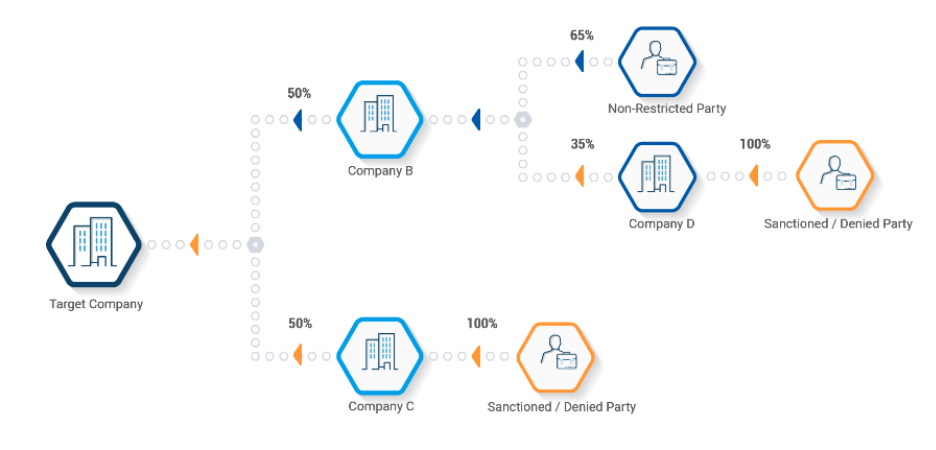
BIS 50 aligns with the Treasury’s OFAC “50 Percent Rule,” which treats any entity owned 50%+ in the aggregate by one or more blocked persons as blocked—even if not named.
The BIS MEU framework requires licenses for certain items when a listed MEU is a party to the transaction; the MEU List is not exhaustive, and exporters must conduct their own diligence for non-listed entities.
Table 1: BIS 50 vs OFAC 50
| BIS 50% Affiliates Rule (BIS 50) | Extends Export Administration Regulations (EAR) licensing restrictions to 50%+ owned affiliates of Entity List parties, MEUs, and certain sanctioned parties; effective via IFR with a transitional TGL. Not all affected entities will be named on the CSL. |
| OFAC 50% Rule (OFAC 50) | Treats 50%+ aggregate ownership (direct/indirect) by blocked persons as blocked—even if not named—across sanctions programs. |
The Challenge: Directional Guidance vs. Explicit Instruction
Under BIS 50, you can no longer rely solely on explicit name matches. BIS explicitly notes that the CSL won’t capture all newly restricted affiliates, pushing companies to adopt risk-based, ownership-aware diligence. This is directional guidance: you must interpret ownership structures and aggregate stakes, not just follow a static list—raising expectations for investigative screening and documentation.
Why BIS is Imposing Ownership-based Restrictions
BIS cites diversion concerns: listed entities have used legally distinct affiliates to procure controlled items, forcing BIS into endless “whack-a-mole” list updates. Extending restrictions to 50%-owned affiliates better protects national security, reduces administrative burden, and aligns with OFAC practice. Listen to this BIS 50 podcast session featuring Descartes’ Jackson Wood for a deeper dive into the origins of the rule.
How the BIS Ownership Rule Works
Any entity 50%+ owned by one or more Entity List or MEU-listed parties (directly/indirectly/aggregated) becomes subject to the same EAR licensing restrictions. The diagram below illustrates how the rule works in the real world.
What BIS 50 Means for Organizations
The BIS 50% Rule makes the international trade compliance process more complex. Companies cannot rely on their internal systems and resources, even for a few shipments. They will need external support to help in the following key areas:
- Broader screening: You must identify hidden ownership links and aggregated stakes across layers and jurisdictions.
- More false positives without the right tools: Legacy name-matching will miss affiliates or overwhelm teams.
- Operational risk: Delays in order release, hold-and-review cycles, and license determinations can impact revenue.
- Regulatory exposure: Violations risk significant penalties, shipment blocks, and reputational harm.
Why Businesses Must Act Now
BIS issued a Temporary General License (General Order No. 7) that permits certain transactions with non-listed foreign affiliates that are ≥50% owned by Entity List or MEU parties for 60 days from the IFR filing date—meant to smooth the transition, not postpone compliance.
Waiting to redesign screening, data feeds, policies, and training invites avoidable violations and disruption over the longer term.
Five-Point BIS 50 Readiness Plan
- Upgrade denied-party screening to include ownership-aware screening
Adopt content and tools that detect direct, indirect, and aggregated ownership and maintain audit-ready trails.
- Map high-risk counterparties and supply chains
Prioritize sectors intersecting with Entity List/MEU exposure; perform enhanced due diligence on complex multilayer structures.
- Integrate checks into ERP/CRM/ordering workflows
Automate screening at onboarding, order booking, shipment release, and vendor management to minimize cycle-time hits.
- Update policies, controls, and training
Codify ownership thresholds, aggregation logic, escalation paths, and documentation standards.
- Prepare for licensing & recordkeeping under compressed timelines
Leverage the TGL where applicable, but build a long-term licensing posture and maintain detailed records for audits.
How Descartes Can Help
Proactive compliance isn’t optional. Descartes offers purpose-built export compliance solutions to handle ownership complexity at scale, with:
- Sanctioned party ownership screening: Uncover indirect and aggregated ownership using enhanced data sources. Our specialized screening data provides deeper visibility into complex ownership chains so you can easily comply with the BIS 50% rule.
- Real-time list updates: Access a global, frequently updated database of denied and sanctioned lists to track evolving regulatory designations.
- Automated workflows: Streamline review, escalation, and documentation with built-in compliance manger workflows.
- AI-assisted denied party screening: Enhance accuracy and accelerate screening with AI-driven precision that reduces false positives by 40 to 60%.
- Streamlined export licensing processes: easily determine and acquire the export licenses required for items that are subject to BIS 50 and other export restrictions.
Find out more about our denied party screening software and contact us to speak to an expert about how we can help your team comply with the BIS 50% rule.