
Descartes Knowledge Center
Why Are Freight Forwarders Looking to Switch Their TMS?
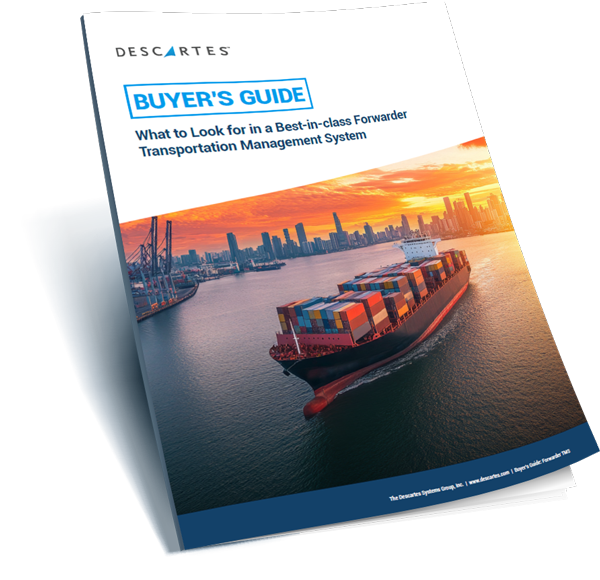
Ready to evaluate if switching your Forwarder Transportation Management System would benefit you? Read more or download the full guide below.
A Quick Overview: What Is a Forwarder TMS?
A Forwarder TMS serves as a central platform for logistics service providers to manage operations. Leading solutions should enable the efficient coordination of shipments from origin to destination, facilitate real-time customer tracking, streamline communication between stakeholders, automate customs clearance and shipment management, and provide valuable insights through rich accounting and data analytics. With the technology at the center of operations, forwarders are empowered to make informed decisions and enhance overall logistics operational efficiency.
Why Are Forwarders Looking to Swap Out Technology?
We have put together a short list of the top challenges that LSPs face and why forwarders are looking to switch their TMS:
Disconnected Systems
Using separate systems for accounting, operations, and Customer Relationship Management (CRM) is cumbersome and labor-intensive. A lack of unified systems can cause information silos, require data re-entry, and prevent C-level executives from gauging business and operational performance.
Limited Connectivity
Attempting to digitally connect with carriers, supply chain partners, and agents manually can tie-up critical resources. Given the complexity and number of connections that are required to move freight and the friction of getting information out of systems in easy-to-use formats, forwarders who take a home-grown approach to connectivity may not be as nimble.
Lack of Automation
Forwarders may struggle with technology that does not automate tasks or provide a framework to speed daily day-to-day work. Such platforms may not feature a template-driven workflow, flag exceptions, or require redundant data entry.
Not Scalable
Some Forwarder TMS’s do not scale with business needs or only offer a limited set of modules. As forwarders expand, the lack of extensibility in a solution can hold businesses back from offering services that customers expect and can curb efficient operations.
Outdated Technology
Using systems housed on an inflexible and aging infrastructure can slow day-to-day tasks. Legacy platforms may also not protect forwarders from cyber threats, ensure data integrity, or only accept outdated data protocols.
Inefficient Technical Support & Training
Customer service may be difficult to access, limited to offshore support teams, staffed by support representatives with rudimentary knowledge of the TMS, or simply be slow to respond. In addition, some technology providers may not provide support after go-live or offer pathways to ensure customer success such as ongoing training and knowledge share sessions.
What Capabilities Does Descartes Forwarder TMS Offer?





Can You Share Some Proven Success Stories of Forwarders Who Switched Their TMS?
Learn how IFF, USA is using Descartes TMS to provide real-time customer-facing visibility
Learn More
Read how A Customs Brokerage is achieving growth with Descartes Forwarder TMS
Learn More
Discover how NorthPoint Logistics is automating workflow and improving customer service with Descartes
Learn More
Read how MSI International is enhancing overall customer service levels and automating processes with Descartes
Learn More