
Key Takeaways
- An ecommerce inventory management system (IMS) is software designed to reduce logistics complexity, prevent overselling, and ensure inventory accuracy.
- Manual processes and spreadsheets break down as order volume and complexity grow, creating errors, delays, and operational bottlenecks.
- An IMS for ecommerce centralizes data, automates workflows, and improves visibility across sales channels, warehouses, and suppliers.
- The right inventory management software helps you forecast demand, optimize purchasing, and scale operations without increasing headcount.
- Modern systems go beyond inventory by connecting order management, shipping, and product listings into one unified workflow.
If you’re running a growing ecommerce business, an inventory management system eventually becomes essential. It provides the foundation that keeps your operations accurate, efficient, and scalable. Without it, you are left juggling spreadsheets, fixing errors, wasting time, and reacting to problems instead of preventing them.
An ecommerce inventory management system is software designed to reduce complexity, prevent overselling, and maintain accurate stock levels across all your channels and locations. For teams managing multiple platforms, warehouses, and suppliers, it brings everything into one place so you can stay in control as you grow.
Table of Contents:
What is ecommerce inventory management?
Common inventory management challenges
When is it time for an inventory management system?
What value does an IMS provide?
Key features of inventory management software for ecommerce
Beyond inventory: order management, shipping, and multichannel listings
What is the best IMS for multichannel ecommerce?
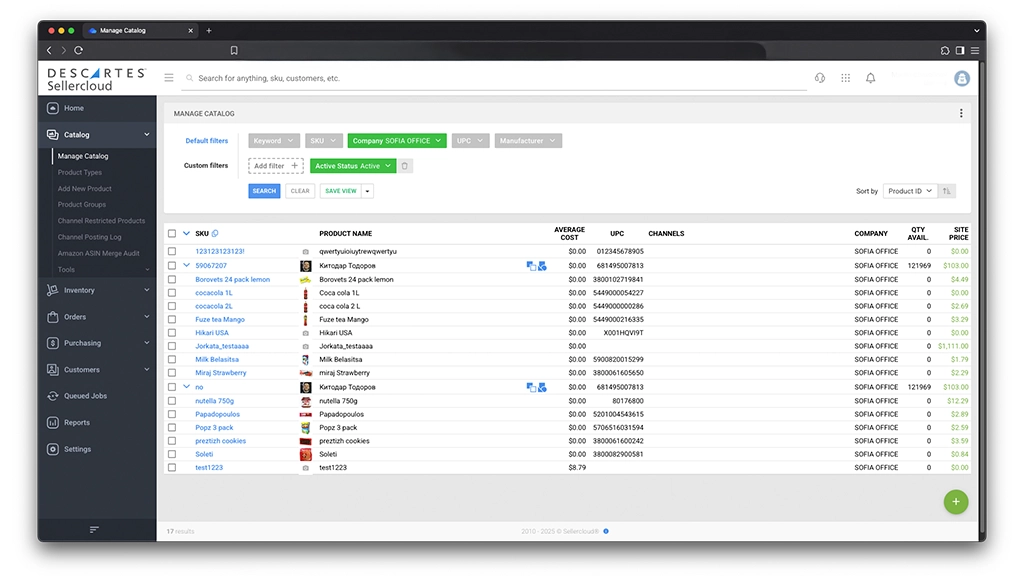
What is ecommerce inventory management?
Ecommerce inventory management is the process of tracking, managing, and optimizing stock across all your online sales channels and order fulfillment locations. This includes your ecommerce storefronts, online marketplaces, warehouses, and any third-party logistics providers (3PLs) you work with.
Ecommerce inventory management encompasses two main areas: physical and online.
Managing physical inventory
Ecommerce businesses usually keep physical inventory in a warehouse, 3PL, brick-and-mortar store, or some combination of the three. As a part of inventory management, workers conduct cycle counts and inventory audits to compare physical inventory to system records.
Warehouse inventory management is how workers track the storage and movement of physical goods in a warehouse. It typically involves barcode scanning, layout organization, receiving, putaway, and workflows related to the pick-pack-ship process.
Managing online inventory
Online inventory management is the process of updating inventory levels for sales channel web platforms to reflect physical inventory availability. When the warehouse receives stock, online inventory must be updated to list the items for sale.
Similarly, whenever ecommerce sales occur on one platform, available inventory must be adjusted on all other sales channels to maintain accuracy. Workers can manually adjust online inventory levels, or you can use inventory management software to automate these adjustments.
Common inventory management challenges
Ecommerce businesses face unique inventory management challenges:
- Showing accurate product availability across platforms like Amazon, eBay, and Shopify
- Managing inventory across multiple locations, warehouses, or even 3PLs
- Keeping up with demand spikes, seasonality, and promotions
- Understanding cost of goods, predicting sales trends, and ordering enough stock
- Meeting sky-high customer expectations for order accuracy and on-time delivery
Unlike traditional retail, ecommerce inventory management requires real-time coordination across multiple online systems. Inventory levels must stay accurate as orders come in from different channels at the same time. Without this synchronization, it becomes easy to oversell products and run out of stock unexpectedly.
When is time for an inventory management system?

Many small businesses manage inventory with spreadsheets. Eventually, as the business grows in order volume and complexity, an inventory management system becomes necessary. Spreadsheets can't scale to keep up with demand.
When to stop using spreadsheets for inventory management
- Overselling due to delays between online sales and manual inventory updates
- Have to keep hiring more back office workers to do spreadsheets
- Inaccurate physical inventory counts and lack of visibility
- Takes too long to compile the necessary data for accurate forecasting
- Human errors frequently cost the company time and money
- Stressful chaos during seasonal peaks and sales events
- Slow order fulfillment and dissatisfied customers
When your business starts to frequently experience any of these issues, it's time to start looking at inventory management software.
Still not sure if it's time for an IMS? Ask an expert
What value does an IMS provide?
At its core, an IMS gives you inventory visibility and control. It helps you move from reactive problem-solving to profitable decision-making.
A modern solution allows you to:
- Increase accuracy - Conduct stock counts, see available inventory, reduce human errors, and catch discrepancies
- Prevent overselling - Sync inventory in real time across all sales channels, locations, and warehouses
- Reduce manual work - Automate fulfillment workflows, stock updates, purchase orders, and low inventory alerts
- Order the right amounts - Forecast demand and automate replenishment based on real data
- Prevent late deliveries - Improve customer experience with faster, more accurate fulfillment
- Make data-driven decisions - Create reports and analyze data to uncover trends and insights
- Scale without adding headcount - Increase warehouse efficiency and throughput with automation
With an IMS serving as a central hub for operations, everything runs smoothly, and it's easier to control operational costs. Orders go out on time, returns decrease, and your team spends less time fixing mistakes.
Ready to look at an ecommerce IMS? Explore Descartes solutions
Key features of inventory management software for ecommerce
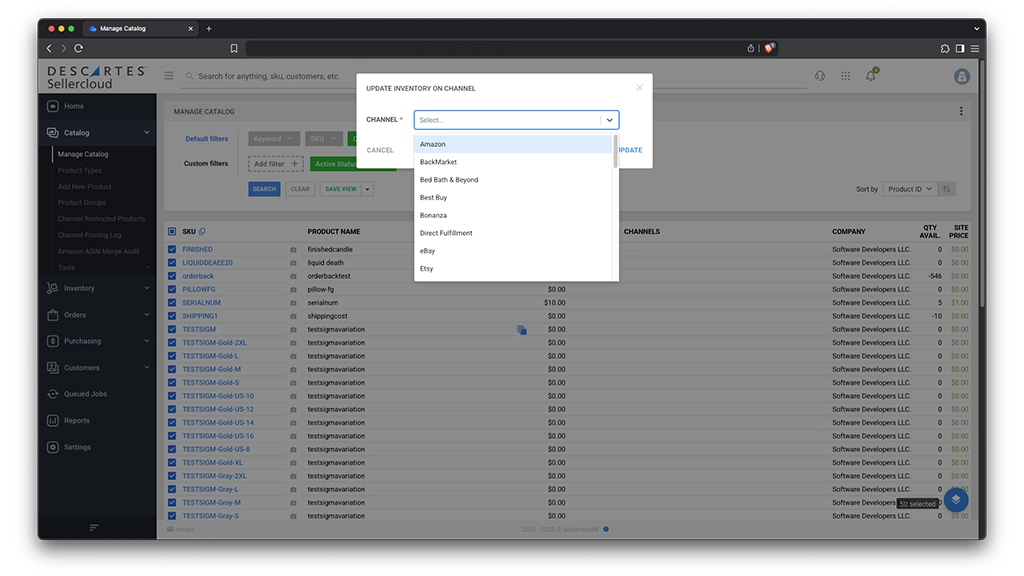
Not all inventory management software is built the same. Multichannel sellers should look for these features when evaluating solutions:
- Centralized inventory visibility
- Multichannel inventory sync
- Automated purchase orders and reordering
- Warehouse management tools
- Inventory reporting and forecasting
Centralized inventory visibility
An inventory management system gives you a single source of truth. You can see stock levels across all warehouses and channels in real time, which helps prevent discrepancies and confusion.
Look for an IMS with stock audit software that provides a complete view of cycle count history, purchase order tracking, sales orders, and stock valuation.
Accurate numbers and robust auditing are especially important for those with multiple warehouse locations and multichannel ecommerce sellers. An IMS should show exactly what is available to sell to customers, when to reorder, and track down irregularities.
Multichannel inventory sync
Whether you’re selling on marketplaces like Amazon and eBay or running a Shopify store, your IMS should automatically update inventory across sales channels. Multichannel sync ensures you never oversell or show inaccurate availability to customers.
Automated purchase orders and reordering
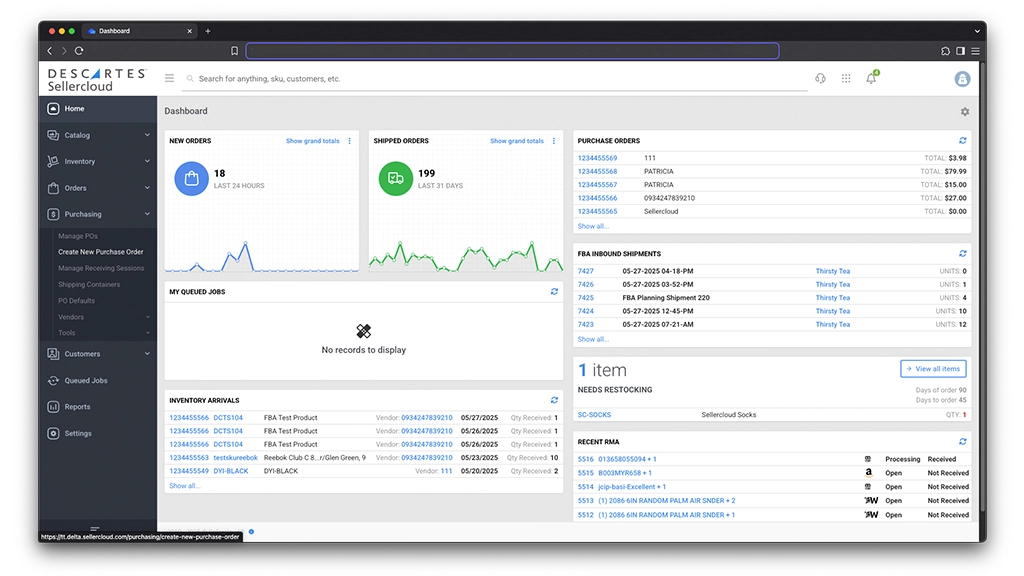
Automating purchase orders and reordering helps you maintain optimal stock levels. With historical data records and forecasting tools, you can make smarter buying decisions and avoid overstocking or stockouts. Track supplier relationships, generate POs, and automatically reorder based on thresholds you define.
See how to create purchase orders using an IMS.
Warehouse management tools
Warehouse inventory management features like barcode scanning, bin tracking, and mobile picking improve fulfillment speed and accuracy. These tools reduce manual errors and help you scale operations during peak seasons.
Look for an inventory management system with barcode scanning and pick-pack-ship workflows. For growing businesses, these features can help bridge the gap between paper-based processes and a full ecommerce warehouse management system.
Kitting and bundling
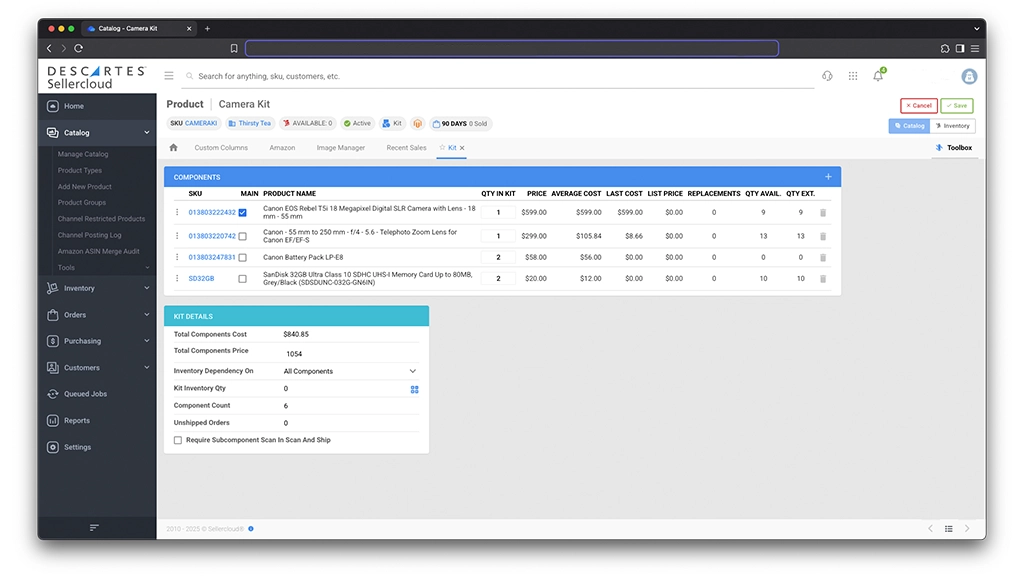
Selling units as product kits and bundles can be complex without the right system. A modern IMS solution tracks component inventory automatically, so you avoid discrepancies when selling kits. No more manual adjustments or inventory mishaps.
Look for an IMS that automatically adjusts stock levels for bundled products and their components. It should also simplify the creation of kits and bundles by supplying the picker with a list of SKUs needed to build the kit.
Learn how to create and sell product kits
Inventory reporting and forecasting
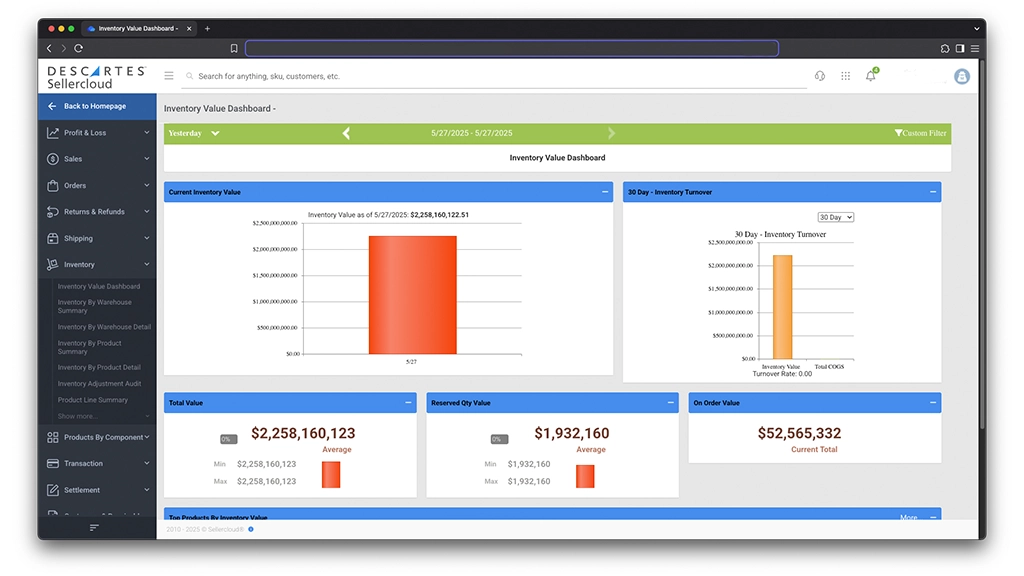
An IMS with customizable dashboards and reports provides visibility and helps you make strategic decisions. You can look beyond basic sales data trends and physical inventory records to identify cost and revenue drivers.
Your IMS should provide a transparent view of inventory’s fiscal impact, such as cost of goods sold, stock velocity, aging inventory, and demand forecasting to enable smarter decision making.
Beyond inventory: order management, shipping, and multichannel listings
The best inventory management software does more than track stock. It connects your entire post-purchase workflow.
This includes:
- Order management to process and route orders from all channels in one platform
- Shipping software to print labels, compare multi-carrier rates, and track shipments
- Product information management to keep product data consistent across channels
Bringing these functions together reduces system sprawl and helps your team work more efficiently.
Looking for all of these capabilities in one platform? Explore Descartes Sellercloud
What is the best IMS for multichannel ecommerce?
Popular IMS software for multichannel ecommerce includes Cin7 Core, Descartes Finale, and Linnworks. Descartes Sellercloud is a popular IMS for Amazon FBA, MCF, and Walmart Marketplace sellers.
High-volume ecommerce brands benefit from warehouse management software with inventory management features, such as ShipHero, Descartes Peoplevox, or Mintsoft.
The market is full of options, but not all are built for the complexity of multichannel ecommerce. Look for customer success stories, reviews, and testimonials from brands like yours as you compare inventory management solutions.
Ultimately, the right system should reduce manual effort, improve accuracy, and scale with your business. Whether you’re shipping 100 orders a day or 10,000, your inventory management process needs to keep up, not slow you down.
Inventory management success stories
Ecommerce inventory management is more complex than traditional retail. Here are two examples of ecommerce brands that overcame inventory management issues with the right technology.
Bambi Baby - Multichannel Amazon seller
Bambi Baby is a leading retailer in the juvenile products space. The business sells on multiple platforms, including their own Adobe Commerce (prev. Magento) site and Amazon.
Before implementing an inventory management system, the company struggled to manage listings and inventory across systems. Bambi Baby previously used ERP software to manage inventory and orders, but they were running into problems.
“There were a ton of bottlenecks that we were experiencing. Shipping was not fluid. Inventory [and] communicating with the website was always a problem,” said Josh Weiss, IT Director of Bambi Baby.
Furthermore, the team still had many manual processes, which were time-consuming and error prone. They also had nothing to let them know when a product was close to being out of stock.
By centralizing inventory, orders, and product content in one place, this brand dramatically reduced fulfillment errors and improved operational efficiency. Today, the warehouse moves tens of thousands of SKUs with confidence, even during peak seasons.
Golf Superstore - Omnichannel seller
Golf Superstore is a sporting goods brand that needed a way to scale with growing demand and sync inventory in real time across Amazon, eBay, Shopify, and a brick-and-mortar store.
“We had outgrown the disjointed legacy technologies that we had in place and needed a platform that could scale with the business,” said Josh Williams, Operations Manager at Golf Superstore.
“With Descartes Sellercloud, we’ve realized significant improvements. As inventory grows, we can now list new products to multiple channels directly from the solution, instead of building product catalogs in three different systems. This cuts out many manual steps and saves time.
It also allows us to easily grade inventory to meet marketplace rules on product quality, track the precise quantity we have for each product grade, and locate specific grades at a bin level.
Finally, reporting dramatically improved because the solution gives us a clear and consolidated picture of data across all channels in real-time, so we can easily maintain accurate and sufficient inventory levels.”
Ready to take control of your inventory?
Managing inventory doesn't have to feel chaotic. With the right inventory management system in place, you can simplify operations, reduce errors, and grow with confidence.
Descartes offers purpose-built inventory management software for multichannel ecommerce sellers. Ready to find out which IMS could work for you?
Inventory management FAQs
Start by evaluating your sales channels, order volume, and operational complexity. Look for a system that supports multichannel syncing, warehouse workflows, and integrations with your existing tools. The right fit should reduce manual work today and support where your business is headed.
Yes. Most modern inventory management systems offer native integrations with major ecommerce platforms and marketplaces, including Amazon, Shopify, eBay, and Walmart. These integrations allow inventory levels, orders, and product data to sync automatically across all channels.
Implementation usually includes system setup, integrations, data migration, and workflow configuration. Many cloud-based platforms can be implemented in a few weeks, while more complex environments with multiple warehouses or ERPs may take longer to fully optimize.
The cost of an inventory management system varies based on your business size, number of users, and required features. Entry-level tools may start at a few hundred dollars per month, while more advanced ecommerce inventory management platforms scale with order volume, integrations, and automation needs.
Yes, especially as your order volume increases. While small businesses may start with spreadsheets, inventory management software becomes valuable once manual processes begin causing errors, delays, or missed sales opportunities.
Inventory management software focuses on tracking stock levels and syncing inventory across channels, while warehouse management software focuses on optimizing warehouse operations like picking, packing, and storage. Many ecommerce businesses use a combination of both as they scale.
Effective ecommerce inventory management starts with maintaining real-time inventory accuracy across all sales channels. Best practices include centralizing inventory data, automating stock updates, conducting regular cycle counts, and using forecasting to plan replenishment. It’s also important to standardize workflows across warehouses and integrate systems to reduce manual errors and delays.
Common techniques include safety stock planning to prevent stockouts, demand forecasting based on historical sales data, and just-in-time (JIT) inventory to reduce holding costs. Other approaches include ABC analysis to prioritize high-value products, batch tracking for traceability, and kitting to manage bundled products efficiently.
An inventory management system (IMS) focuses on tracking, syncing, and optimizing inventory across channels and locations. An enterprise resource planning (ERP) system is broader and includes accounting, finance, procurement, and other business functions. While an ERP may include basic inventory features, an IMS is typically more specialized for ecommerce operations.
Businesses with complex financial operations, multiple legal entities, or advanced accounting requirements often benefit from an ERP. This includes large enterprises, manufacturers, and companies managing global supply chains. Many ecommerce brands use an IMS alongside an ERP, using the IMS for operational execution and the ERP for financial and back-office management.